 Chatfuel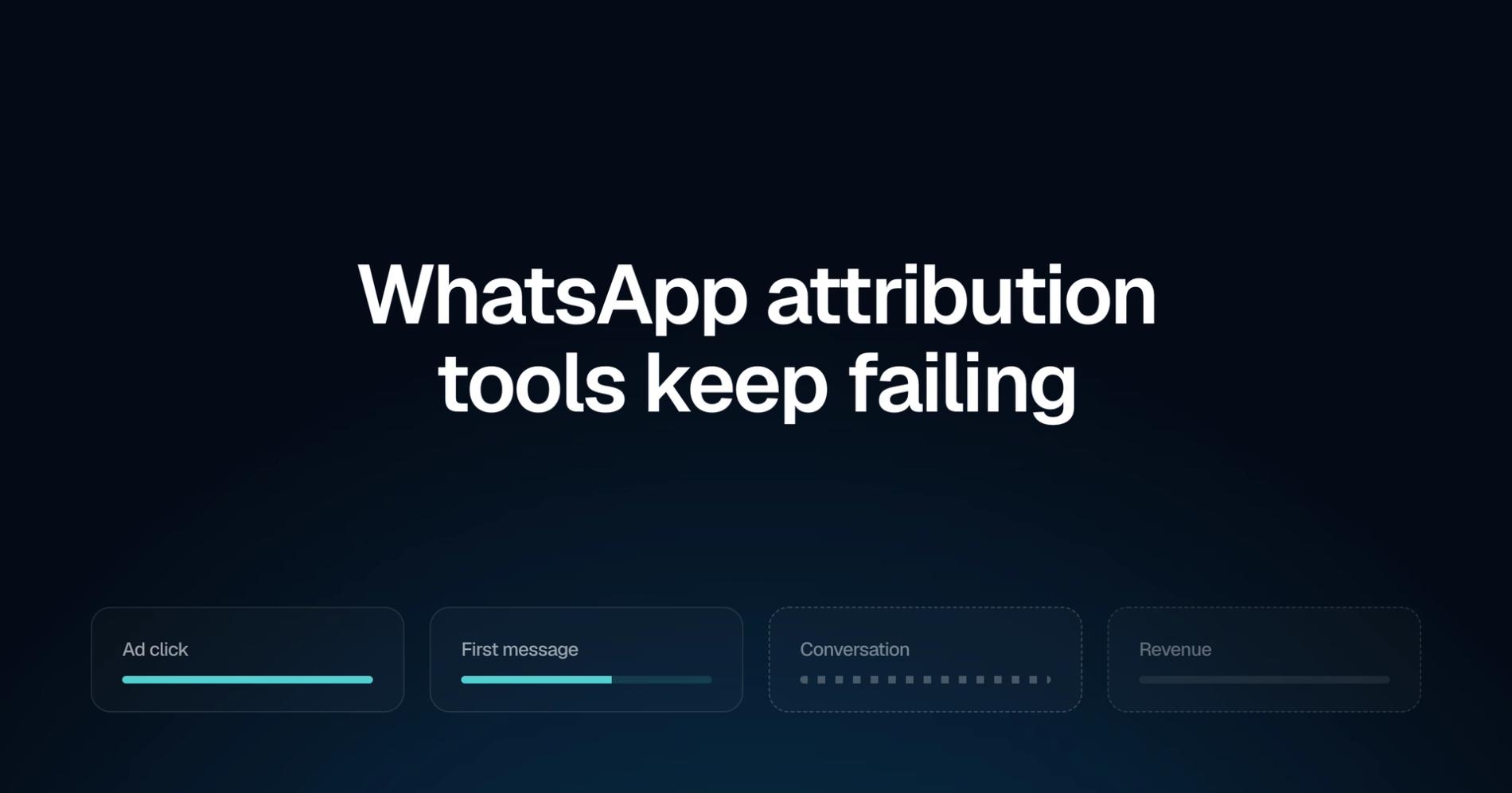
Every tool in this category promises the same thing: tell an agency which ad actually produced a sale, not just a conversation. Look closely at how each one gets to that answer, and a pattern shows up. Almost none of them derive the outcome from the conversation itself. They infer it from a fragile proxy — a typed keyword, a dragged card, a screenshot, an overnight AI guess — and every one of those proxies breaks in situations that happen constantly in real sales conversations.
There's no Pixel inside a WhatsApp chat
It's worth naming the root cause before going through the failure modes one by one. On a website, a Pixel sits in the browser and watches the page load, the button click, the checkout confirmation — it has a direct line to the event. Inside a WhatsApp conversation, none of that exists. No browser, no page, no JavaScript running anywhere. Every tool in this category is trying to answer the same question — did this conversation turn into a sale — from outside a system it doesn't control. That's the constraint everything below is a workaround for. (See our full breakdown of Conversions API vs Meta Pixel → for how the same underlying gap plays out on the website side of this problem.)
This is also why plain UTM tracking, the default answer for everything else in marketing, mostly falls apart here. A deep link can carry a UTM parameter up to the moment someone taps it — but once the conversation opens inside WhatsApp, that parameter has nowhere to persist. There's no cookie, no local storage, no page for it to live on. This is the actual mechanism behind a common, real complaint on r/PPC: advertisers who set up Click-to-WhatsApp campaigns and can't get GA4 to show them anything past "conversation opened."
Keyword-based WhatsApp attribution breaks on an emoji
Tintim, the market leader, detects a sale when an agent types a pre-configured trigger phrase into the chat. The match ignores case, accents, and periods — but it breaks on an exclamation mark or an emoji. Tintim's own documentation tells users to save the phrase as a WhatsApp quick reply "to avoid typing errors." That instruction exists because the alternative is an agent typing "Obrigada pelo contato! 😊" instead of the exact configured string, and the sale silently going unrecorded. (For a fuller look at how Tintim works end to end, see our Chatfuel vs Tintim comparison →.)
Exact-match attribution inverts on a discount
Metrito takes a different approach: literal string matching, with the rule that "the message must be identical to the configured term, including accents, spaces and capital letters." For the value of the sale, Metrito's own documentation states it plainly: it takes the largest number in the message. Their example works fine. But the most ordinary sales sentence in Brazil breaks it: "De R$997 por R$497" books 997, not 497. Quote a competitor's price, mention an installment plan, or type any incidental larger number, and the recorded revenue inflates. Nothing in the system can catch it.
The human has to remember to do it
SuperLead's approach is a per-client funnel builder where an agent manually drags a card to advance a stage and fire the event. No AI, no keyword — just a person remembering to do it every time. When they don't, nothing happens, and there's no way to tell the difference between "no sale" and "sale that nobody logged." SuperLead names its modules well — one is literally called "The Report That Shuts Them Up," built to prove a client's leads were real — but the module still depends entirely on someone dragging a card correctly, every time, forever.
Some tools skip detection and just read the receipt
At least one tool in this category sidesteps the conversation entirely: it reads a payment receipt screenshot posted in the chat and extracts a purchase amount from the image. That solves the keyword problem, but it creates a narrower one — anything paid offline, by card in person, or agreed verbally without a screenshot is invisible to the system. The detection mechanism only works for the specific behavior it was built to read.
Even AI-based sale detection still asks permission overnight
Tintim shipped an AI layer, Inspetor de Vendas, in July — the most advanced detection mechanism anyone in this category has built, with a claimed 90-92% accuracy. It still runs once a day, overnight, showing a confidence score and the surrounding messages, and waits for a human to approve each one the next morning. That approval can't be undone. The system reads text only, so a sale closed by voice note or confirmed with a photo of a receipt never enters the review queue at all. Even the best version of this approach doesn't trust its own read of a conversation enough to act on it in real time.
How WhatsApp Coexistence breaks ad attribution
Loopim's own documentation describes a failure mode most companies wouldn't publish voluntarily: under WhatsApp's Coexistence mode, "WhatsApp often cleans this metadata before sending it to our API." When that happens, a lead that came from a paid ad gets silently reclassified as organic traffic. Meta support reportedly told them there's no workaround. For a tool whose entire job is proving an ad worked, quietly losing the ad attribution and mislabeling the result is close to the worst failure available.
The one exception, and what it costs
One tool in this category avoids all of the above: it fires an event only when a deal is marked closed inside a CRM, with the revenue figure the CRM already has on record. No keyword, no dragged card, no AI guess — the outcome comes from a system of record instead of a human typing or clicking something. It's the most rigorous mechanic in the entire segment, and it comes from actually requiring the piece everyone else works around: a CRM has to already exist, already hold the deal, and already be the thing the sales team updates. That's a real cost most small agencies and their clients don't meet, which is exactly why the rest of the category invented keyword matching and Kanban drags in the first place.
The evidence base has its own conflicts of interest
It's not just the technology that leans on shaky proxies — so does the public record used to evaluate it. Independent reviews are close to nonexistent across this entire category: no G2, Capterra, or Trustpilot listings for most of these tools. What passes for independent evidence often isn't. The most-cited third-party article criticizing the market leader was written by someone who also produces onboarding tutorial videos for a direct competitor, with no commercial relationship disclosed. A testimonial used as social proof by one tool is attributed to an "agency owner" whose LinkedIn lists him as a co-founder of that same company. When the reviews are this thin, a single unresolved complaint carries more weight than it should have to.
What all of this adds up to
None of these are edge cases. An emoji in a reply, a discount mentioned in a sentence, a busy agent forgetting to drag a card, a metadata field WhatsApp strips by design — these happen in the ordinary run of a sales conversation, not in unusual ones. And the consequence shows up where it's hardest to ignore: one Tintim customer, testing the tool with two clients who weren't running any Meta ads at all, reported that three leads had already been attributed to Meta campaigns that didn't exist. The complaint is still unanswered.
The common thread is structural, not a matter of any one company executing poorly. Every tool in this category watches a conversation happening somewhere else and tries to reconstruct, after the fact, whether it ended in a sale. That reconstruction always runs through some proxy — because none of them are the thing actually running the conversation, and only that system knows for certain what happened inside it.
Common questions about WhatsApp attribution
What is the Meta attribution app? Meta doesn't ship a single dedicated "attribution app" for WhatsApp. Attribution runs through the same Events Manager and Conversions API that handle website conversions — configured per business, not through a standalone product.
Which WhatsApp tool is best for business? That depends entirely on what "the tool" needs to do. A pure attribution layer bolted onto automation you already run is a different choice than a system where the automation and the attribution are the same product. The right answer is the one whose failure mode you can actually live with — see the breakdowns above before picking.
What changes when attribution runs inside the conversation, not beside it
A booking confirmed on a calendar, a status change in a pipeline, a handoff to a human agent — these aren't proxies for what happened. They're the thing that happened, recorded by the same system that carried out the action. There's no keyword to mistype, no card to forget dragging, no metadata to lose along the way, and no separate CRM that has to exist first for it to work.
That's the structural difference Chatfuel's Conversions API integration is built around: automation and attribution running as one system, not one product guessing at what another product did.