 Chatfuel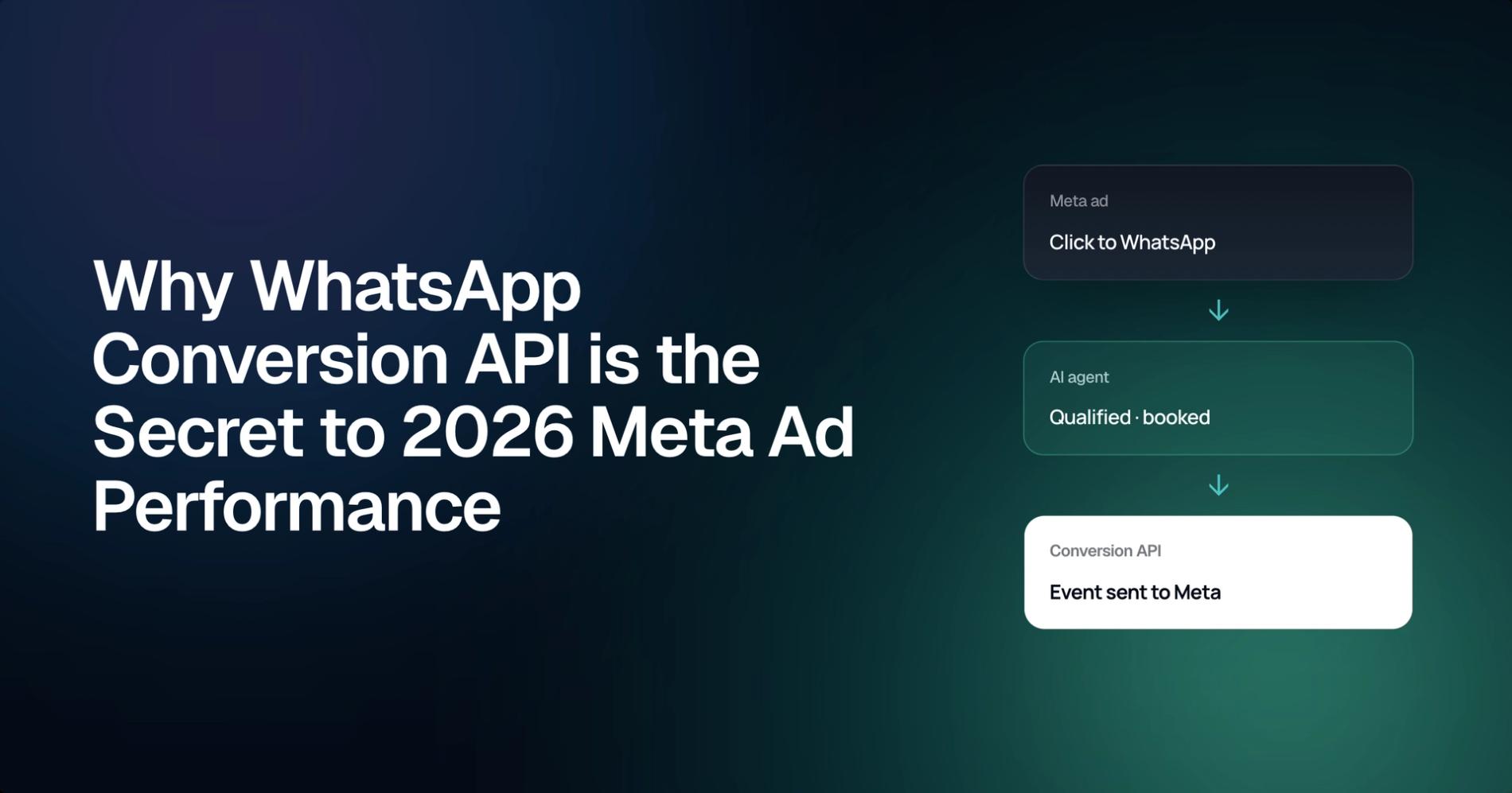
The Visibility Gap in WhatsApp Marketing
Most marketers running Click-to-WhatsApp ads can see when a conversation starts — but they go completely blind the moment a lead types "hello."
That blind spot is costing more than most teams realize. Click-to-WhatsApp ads have already reached a $10 billion annual revenue run-rate, which tells you exactly how much budget is flowing into this channel. And yet the dominant success metric for most campaigns is still "Conversation Started" — a number that tells you almost nothing about whether those conversations turned into customers.
"Conversation Started" is a vanity metric. In a high-volume environment, it's trivially easy to drive thousands of chat openings. What you can't see with standard CTWA metrics is who qualified, who was nurtured, and — most critically — who bought. Without that downstream data, Meta's algorithm has no choice but to optimize for the cheapest conversation, not the most valuable one. The result is a feed full of low-intent leads that drain your budget and skew your reporting.
The shift toward signal-based marketing means that feeding rich, down-funnel events back to Meta is no longer optional — it's the performance baseline. The WhatsApp Conversion API exists precisely to close this loop: passing real purchase and qualification signals from your WhatsApp conversations back to Meta so the algorithm can find leads that actually convert. Understanding why that connection matters — and what happens without it — is where we need to start.
Why the Conversions API is Non-Negotiable for CTWA Ads
The WhatsApp to Meta Conversions API integration is the infrastructure layer that turns your ad spend from a guess into a feedback loop Meta can actually learn from.
The core mechanism is straightforward. Instead of relying on a browser-based pixel to fire a signal when something meaningful happens, CAPI sends conversion events directly from your server to Meta. That distinction matters enormously in practice — browser pixels drop data every time a user blocks tracking, switches apps, or has a spotty connection mid-conversation. Since WhatsApp conversations happen inside a mobile app rather than a browser, a pixel alone was never built for this environment. Understanding how server-side reporting differs from pixel-based tracking clarifies why closing that gap is essential for CTWA campaigns specifically.
Down-funnel signal quality is where this really changes the economics of your campaigns. When Meta's algorithm only sees conversation-start events, it optimizes for volume — finding the most people likely to click "Send Message," regardless of whether they ever intend to buy. Feed it qualification events, purchase confirmations, or high-intent responses instead, and the algorithm shifts toward value-based bidding: finding users who resemble your actual buyers, not just your chattiest leads.
The performance difference is significant. Click-to-WhatsApp ads already deliver a 94% conversion lift over traditional ad formats — and that figure assumes you're capturing meaningful signal. Without CAPI passing those down-funnel events back to Meta, you're running a high-performing channel at a fraction of its ceiling. The algorithm is only as smart as the data you give it.
That's what makes the integration non-negotiable: it's not a reporting upgrade, it's the signal layer that determines whether your campaigns improve over time or plateau. And the quality of those signals depends directly on how you define and trigger qualification events inside WhatsApp — which is exactly what we'll map out next.
Mapping the 'Qualified Lead' Event Flow
Defining what counts as a "qualified lead" inside WhatsApp — and triggering that signal automatically — is what separates campaigns that scale from campaigns that stall.
The qualification logic starts inside the chat itself. Chatfuel's automated lead qualification system routes each conversation through a structured question sequence covering budget range, purchase timeline, and stated intent. When a lead's answers clear every threshold you've defined, the system doesn't wait for a human to flag it — it fires immediately.
Here's how that event flow works in practice:
Chatbot question sequence — The bot collects budget, timeline, and intent data through guided prompts, scoring each response against your predefined criteria.
Logic gate — Once all qualification conditions are met, the automation triggers a webhook, packaging the relevant conversation data into a structured payload.
API trigger — That webhook fires the
Leadstandard event and sends WhatsApp events to Meta pixel in real time, passing parameters like budget tier and intent score alongside the standard event.Meta mapping — Custom WhatsApp parameters get mapped to Meta standard event fields, so the algorithm receives rich, actionable signal — not just a generic contact event.
Running this kind of automated qualification at scale significantly impacts your campaigns. AI-powered WhatsApp chatbots recorded an average lead generation increase of 619% — a figure that reflects what happens when qualification runs continuously without human bottlenecks. For agencies managing multiple client accounts, that throughput is impossible to replicate manually. Automating the event flow means every conversation either qualifies a lead or filters out low-intent traffic, and Meta's algorithm gets smarter with every signal.
This same logic extends naturally to service-based businesses — where the next conversion event isn't a purchase, but a confirmed appointment.
Tracking 'Booking' Events for Service-Based Businesses
WhatsApp booking conversion tracking solves the critical gap between a lead who showed interest and a client who actually committed to a time slot.
For service-based businesses — think clinics, law firms, real estate agencies, or coaching practices — a "Lead" event and a "Booking" event are fundamentally different signals. Someone who replies to your Click-to-WhatsApp ad is top-funnel. Someone who confirms a specific appointment time is mid-funnel, high-intent, and far more predictive of actual revenue. Collapsing those two events into a single conversion category means Meta's algorithm can't distinguish between a curious click and a genuine prospect ready to show up.
Chatfuel's automated lead qualification system seamlessly integrates with scheduling tools inside the WhatsApp conversation flow. Once a lead clears the qualification criteria, the chatbot presents available time slots, captures the confirmation, and triggers a Schedule event back to Meta via the Conversions API — automatically, without any human involvement required. That signal tells Meta exactly what a high-value user looks like, so future campaigns optimize toward users who book, not just users who chat.
The opportunity to scale here is substantial. WhatsApp Business has over 200 million monthly active users, which means your scheduling integration isn't a niche workaround — it's a conversion layer built on top of a channel your audience already uses daily. And optimizing campaigns specifically for the Schedule event rather than a generic lead event directly reduces no-shows, because Meta targets your ads to users whose behavior patterns indicate they will follow through.
Configuring your accounts and permissions correctly is crucial for clean signal flow into Meta — which is exactly where we'll focus next.
Connecting Chatfuel to Meta: What It Actually Takes
Sending WhatsApp signals to Meta doesn't require you to hand-build a server-side integration — Chatfuel handles the technical layer for you.
Here's what the setup actually looks like:
Install the integration. In your Chatfuel Panel, go to Settings → Integrations, find Facebook Conversions API, and click Install.
Grant access. Authorize the connection through Meta's built-in access flow — a few clicks, no manual access tokens to generate or scope yourself.
Dataset created automatically. Meta creates a Dataset in Events Manager tied to your WhatsApp Business Account ID and connected Page. You never search for or enter a Pixel/Dataset ID by hand.
Send events. Once connected, send standard events (Lead, Purchase, Schedule) or custom events straight from your Chatfuel flow — customer data gets mapped automatically.
That's the entire technical lift. No system user permissions to configure manually, no External ID mapping to build yourself — the integration is designed so agencies can connect a WhatsApp number to Meta's ad algorithm without touching raw API credentials.
Summary: The Path to WhatsApp ROI in 2026
To optimize CTWA ads in 2026, you need to stop measuring conversation volume and start measuring conversion quality — and that shift starts with how you define, trigger, and transmit events back to Meta.
The sections above laid out each piece of this infrastructure: event definitions, booking flows, and the technical stack required to carry clean signals from WhatsApp into Meta's algorithm. Pulling those pieces together into a single strategic picture makes the path forward clear.
Here's what the loop looks like when it's fully closed:
Track the right events. "Conversation Started" tells you someone tapped your ad.
LeadandScheduleevents tell you someone is actually worth pursuing. Meta's algorithm can only optimize for what you measure, so measuring shallow signals produces shallow results.Use the Conversions API — no exceptions. Browser-based tracking can't follow a user from ad click into a WhatsApp thread. The Conversions API is the only reliable bridge between what happens inside the chat and what Meta's delivery system learns from it.
Automate qualification to handle scale. AI-powered WhatsApp tools have demonstrated significant increases in lead volume. Without automated qualification logic running 24/7, that volume becomes noise rather than pipeline.
Map your technical stack correctly. Your WABA, your CAPI connection, and your Meta Dataset must be linked under the same Business Portfolio — with the right system user permissions in place. One broken link in that chain and your events arrive unattributed.
What this framework doesn't do on its own is remove the complexity of building and maintaining the qualification logic, the event triggers, and the Meta integration. That's where having the right automation layer makes the difference between a system you can scale and one you're constantly patching. In the next section, we'll look at exactly how Chatfuel handles that — from automated Qualified Lead logic to native event reporting — so your WhatsApp funnel can grow without growing your overhead.
Key Takeaways:
Shift from vanity metrics to conversion events — tracking
LeadandScheduleevents instead of "Conversation Started" gives Meta the signal quality it needs to improve campaign delivery.The Conversions API is non-negotiable — it's the only way to pass WhatsApp conversation data back to Meta and close the attribution gap that makes CTWA campaigns hard to scale.
Automation handles the volume — AI-powered qualification running continuously is the only practical way to process high lead volumes without sacrificing signal acaccuracy.
Infrastructure alignment determines signal integrity — your WABA, CAPI setup, and Meta Dataset must be correctly mapped, with proper system user permissions, before any event data becomes actionable.
Scaling Your WhatsApp Funnel with Chatfuel
Chatfuel automates the qualification and event-sending processes described here — no custom coding, no stitched-together integrations, no signal gaps.
The "Qualified Lead" logic that most teams spend weeks building manually is handled inside Chatfuel's automated lead qualification system. You define the criteria — budget confirmed, timeline answered, service matched — and Chatfuel runs those qualification checks across every conversation, continuously, at scale. When a lead clears your threshold, the system fires the corresponding event directly to Meta Ads Manager through a native Conversions API connection. That means your campaign optimization loop tightens without anyone on your team manually pulling data or updating spreadsheets.
Automated reporting is where agencies and sales teams reclaim the hours that attribution work used to consume. Chatfuel tracks which leads move through each stage of the funnel and delivers reporting that shows, concretely, which WhatsApp conversations converted into sales. That's the system that proves which lead became a sale — not an estimate, not a correlation, but a traceable signal tied to a real outcome.
And that's ultimately what closing the attribution loop means in practice: your ad spend earns cleaner data with every campaign cycle, Meta's algorithm improves its targeting, and you can demonstrate ROI to clients or stakeholders with reports generated automatically rather than assembled manually.
If you're ready to stop optimizing for conversation volume and start proving conversion quality, start your free Chatfuel trial and connect your WhatsApp funnel to Meta with the infrastructure that makes it measurable.
FAQs
What is the WhatsApp Conversions API?
The WhatsApp Conversions API (CAPI) is a server-side integration that sends conversion events — such as qualified leads, purchases, and bookings — directly from your WhatsApp automation platform to Meta. Unlike browser-based pixels, CAPI works reliably inside the WhatsApp app environment where pixel tracking cannot reach.
How does the Conversions API improve Click-to-WhatsApp ad performance?
By sending down-funnel events like "Qualified Lead" or "Schedule" back to Meta, the Conversions API enables the ad algorithm to optimize for high-value outcomes instead of just conversation starts. This shifts campaign delivery toward users who are more likely to convert, reducing cost per acquisition and improving overall ROI.
Do I need a developer to set up the WhatsApp Conversions API?
Not with Chatfuel. The integration is fully no-code — you install it from the Chatfuel Panel settings, authorize through Meta's access flow, and start sending events. No manual access tokens, system user permissions, or custom server-side code required.
What conversion events can I send through the WhatsApp Conversions API?
You can send any Meta standard event such as Lead, Purchase, and Schedule, as well as custom events. With Chatfuel, events are triggered automatically when contacts meet qualification criteria or complete specific actions in the chatbot flow, like confirming an appointment or completing a purchase.