 Guest experts
A few years ago, a no-code chatbot builder meant a canvas of boxes and arrows. You drew every question, button and answer, and the bot followed the map until a customer typed something the map didn't cover.
Today most builders put an AI agent at the center. You give it your prices, policies and open hours, it answers customers in its own words, and you still don't write a line of code. Some tools even let you set everything up by chatting with an assistant. We compared 5 no-code chatbot builders on how you build, channels, AI and price:
- Chatfuel: an AI Agent for WhatsApp, Instagram, Messenger, TikTok and website chat that you set up by describing your business
- Landbot: a drag-and-drop builder for website and WhatsApp lead flows
- Manychat: a visual flow builder for Instagram, TikTok and Messenger automation
- Wati: a WhatsApp-first platform with a no-code bot builder and broadcasts
- Tidio: website live chat with drag-and-drop Flows and the Lyro AI agent
See also: 9 best conversational AI platforms for business
What is a no-code chatbot builder?
A no-code chatbot builder is a tool that lets you launch a chatbot on your website or in messaging apps without programming. You set it up in a visual editor or in plain language, connect your channels and turn it on.
Builders follow one of two approaches:
- Flow builders (Landbot, Manychat, Wati, Tidio Flows). You draw the conversation as a diagram of messages, buttons and conditions. Flows are predictable and work well for fixed paths like a quiz or a lead form, but every new question needs a new branch, and a price change means editing every block that mentions it.
- AI agent builders (Chatfuel). You give the AI agent your business information and a few rules, and it writes each answer itself. There's no diagram to keep up to date: when a price changes, you change it once in the knowledge base.
Most flow builders now sell an AI agent as an add-on or on higher plans. Chatfuel went the other way and replaced its flow builder with Automations, where you set up how the AI Agent behaves on each channel.
No-code chatbot builders compared
| Tool | How you build | Channels | AI agent | Price from (monthly) |
|---|---|---|---|---|
| Chatfuel | Describe your business, or ask AI Co-pilot | WhatsApp, Instagram, Messenger, TikTok, website chat | Included on every plan | $20 with $20 in credits; 7-day trial |
| Landbot | Drag-and-drop flows, AI drafts a flow from a prompt | Website, WhatsApp, Messenger | AI chats counted separately | Free plan (100 chats); paid from $45 |
| Manychat | Visual Flow Builder | Instagram, TikTok, Messenger, Telegram, WhatsApp, SMS, email | From the Pro plan | Free plan (25 contacts); paid from $17 |
| Wati | No-code WhatsApp bot builder | WhatsApp, Instagram, Messenger, TikTok, website | Astra add-on from $99 | $69 plus Meta's WhatsApp fees; 7-day trial |
| Tidio | Drag-and-drop Flows, 40+ templates | Website, Messenger, Instagram, WhatsApp, email | Lyro add-on from $39 | Free plan (50 conversations); paid from $29 |
Prices as listed on each vendor's website in October 2026, in US dollars, with monthly billing. Yearly billing is cheaper on every platform.
5 best no-code chatbot builders
1. Chatfuel
Chatfuel is a no-code platform for an AI Agent that answers customers on WhatsApp (through the official WhatsApp Business Platform), Instagram, Facebook Messenger, TikTok and your website. You don't draw flows. You tell the AI Agent about your business, and it answers questions, books appointments and hands chats to your team.
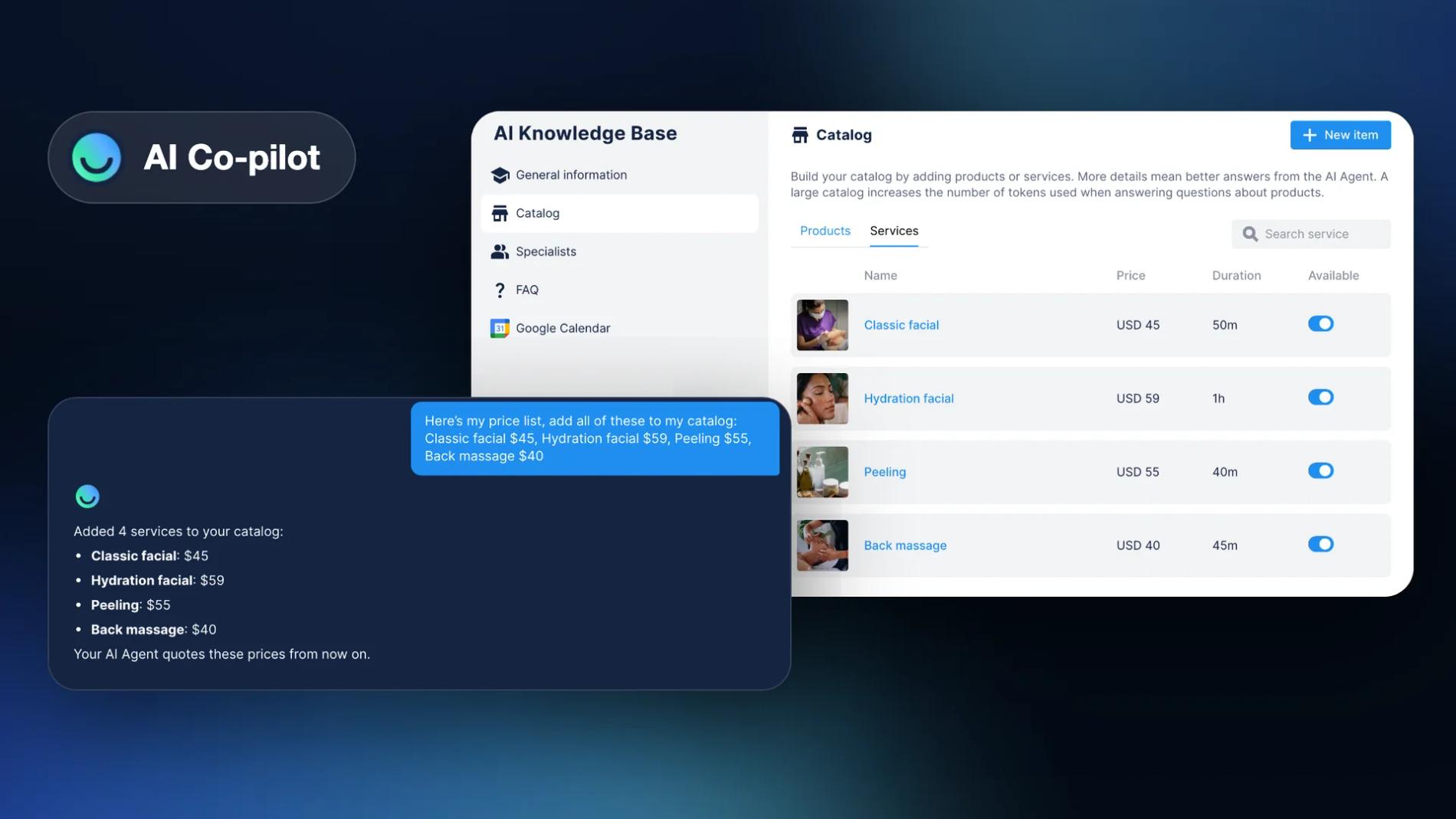
The quickest way to set it up is to talk to AI Co-pilot, the assistant built into Chatfuel. Paste your price list, attach a PDF or describe a rule in your own words, and AI Co-pilot fills in the AI Knowledge Base and changes the settings for you.
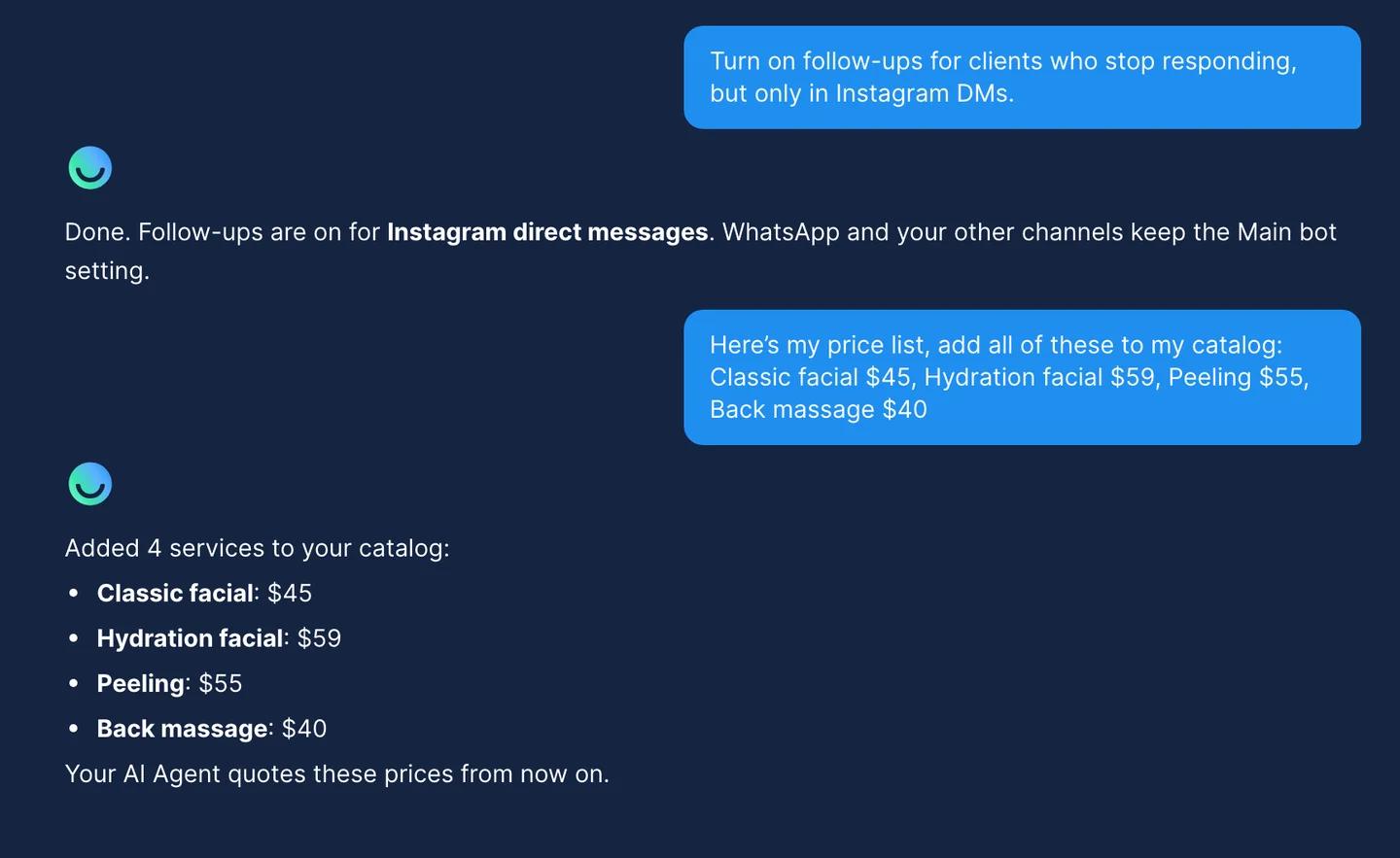
What you get:
- Setup in plain language. AI Co-pilot fills your knowledge base, builds your catalog, writes AI instructions, adds handoff rules and configures any automation. Only connecting a channel needs you to log in yourself. You can also manage Chatfuel from Claude, ChatGPT or Cursor through the Chatfuel MCP server.
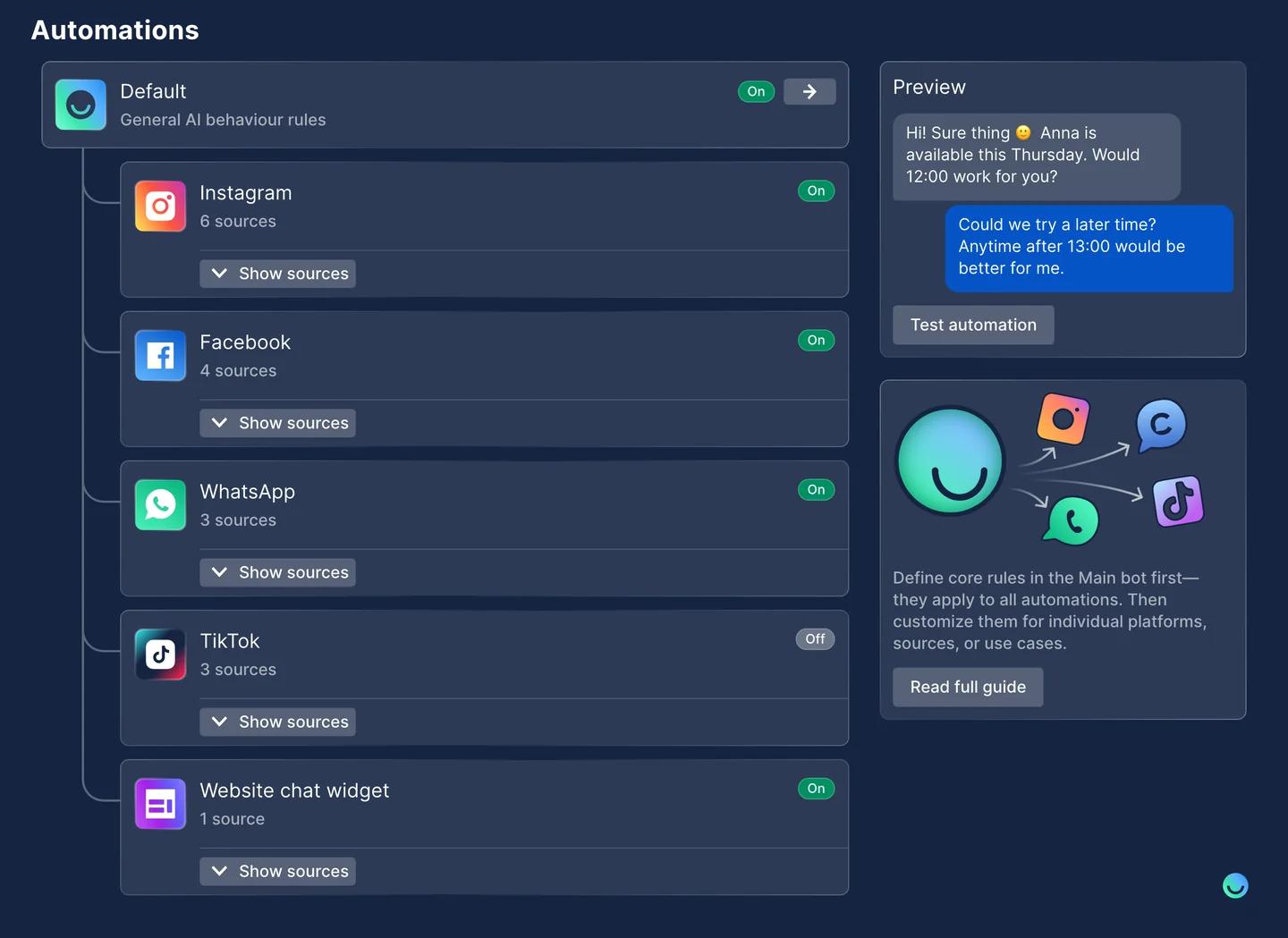
- One AI Agent for five channels. In Automations, the Default settings apply everywhere, and each channel (WhatsApp, Instagram, Facebook, TikTok, website) can have its own. Comments on Instagram, Facebook and TikTok posts get replies too.
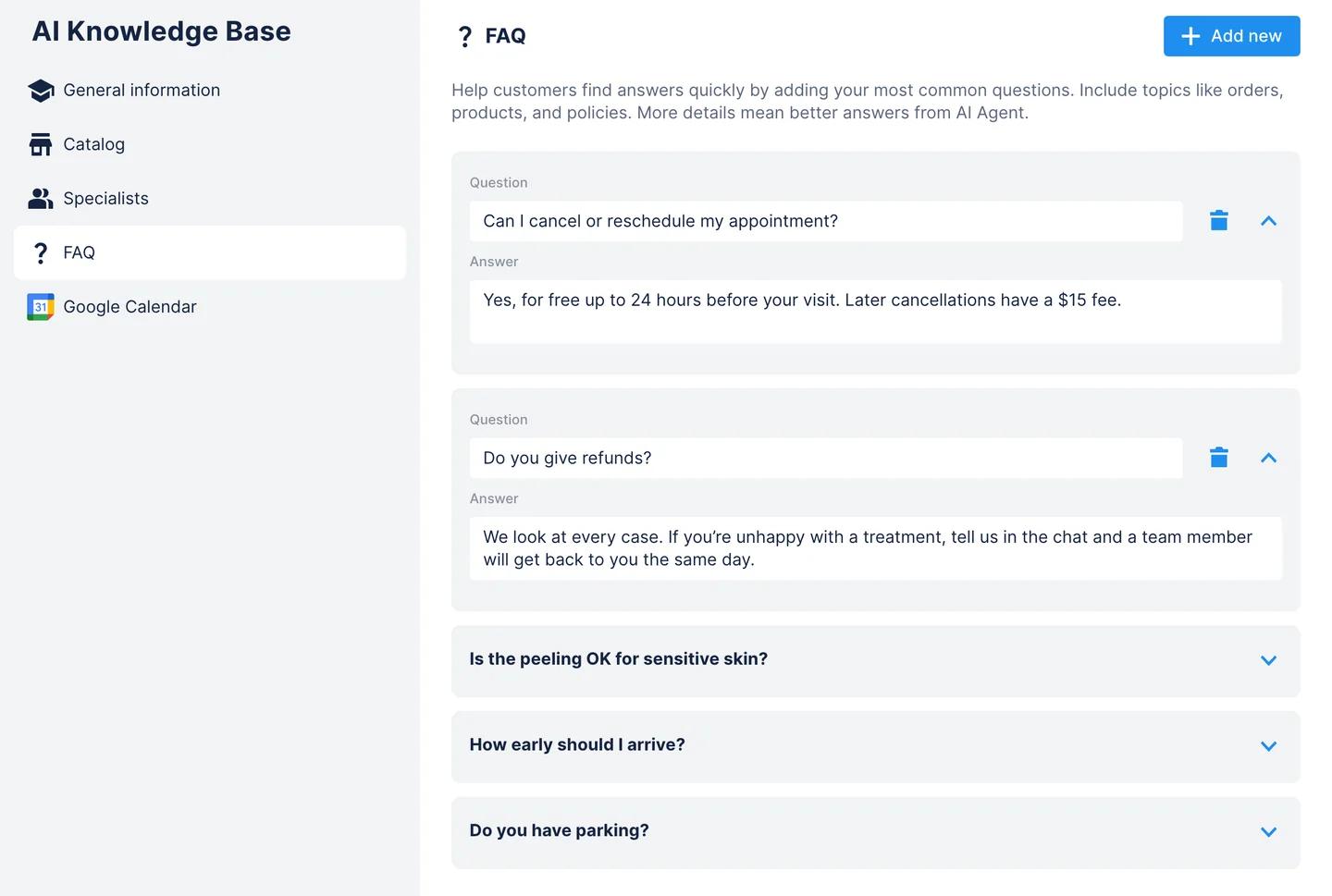
- Answers from your information. The AI Agent replies from your AI Knowledge Base: general information with open hours, a catalog with prices and photos, and an FAQ with your policies.
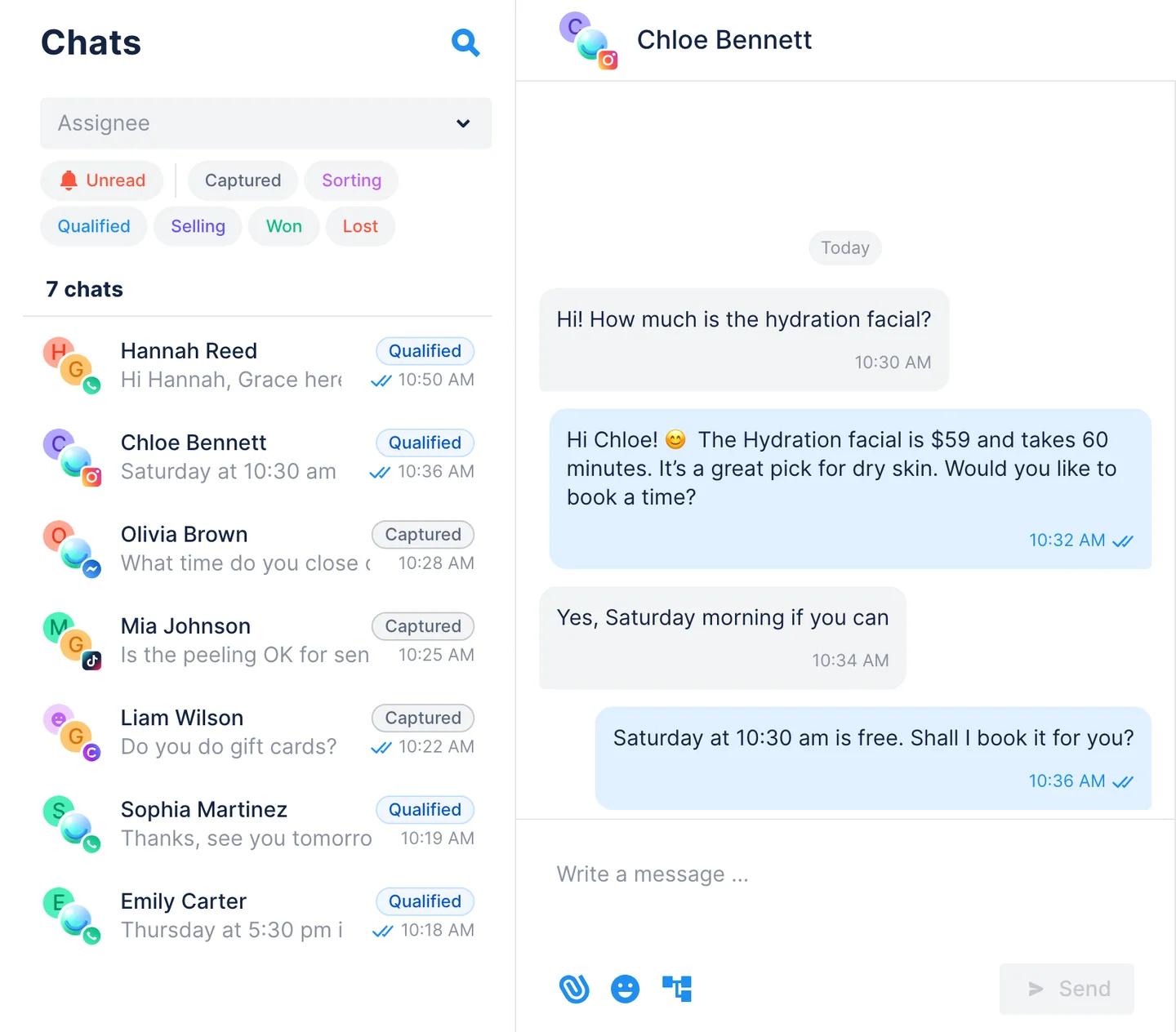
- Bookings and leads. It offers free slots and books appointments in the Calendar. Lead Qualification saves the contact details customers share, and Send follow-ups reminds people who went quiet (AI follow-ups).
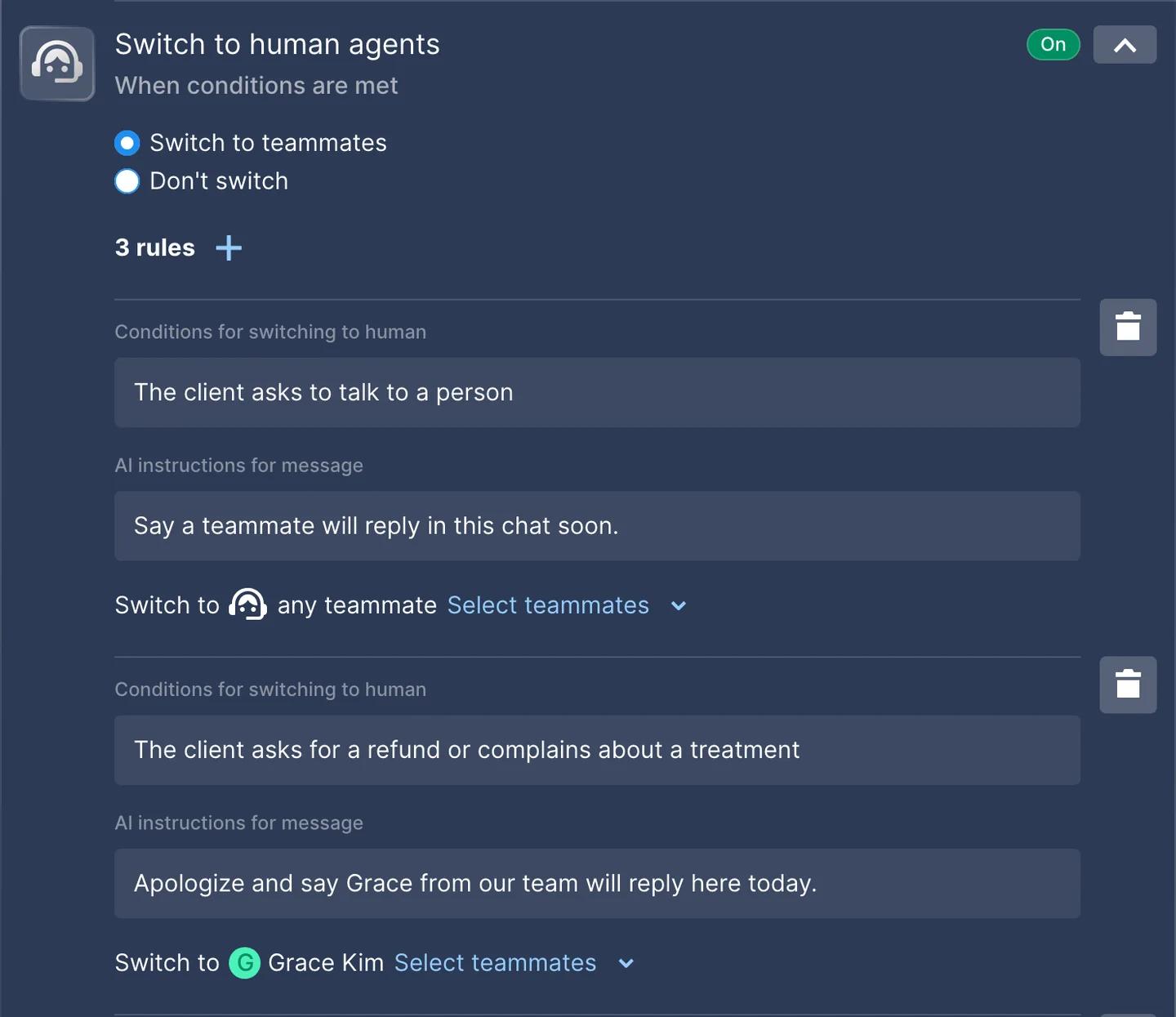
- Your team behind it. In Switch to human agents, you describe when a chat goes to a person and who gets it. Your team replies in Chats.
Pricing: the Business plan costs $20 a month and includes $20 in credits for AI replies and messages. Agency plans for several client companies start at $100 a month, and yearly billing saves 10%. Every plan includes all channels, unlimited contacts and teammates, and no seat fees. Meta's WhatsApp message fees come out of the same credit wallet. Each plan starts with a 7-day free trial with $15 in credits. See Chatfuel pricing.
Results: HelloFresh built its Messenger support bot on Chatfuel and cut its average response time by 76%. The fashion resale platform TheCultt automated its Instagram chats and raised conversion to purchase by 37%.
Best for: small and midsize businesses whose customers write in WhatsApp, Instagram, Messenger, TikTok or website chat, and who want the AI agent live the same day without drawing a single flow.
Keep in mind: Chatfuel builds AI agents, not button menus: the AI writes every reply as text. It works in messaging channels only, without email, SMS, phone calls or Telegram, and there's no free plan, only the trial.
2. Landbot
Landbot is a no-code builder for conversational flows on websites and WhatsApp, popular with marketing teams that collect and qualify leads. You build on a drag-and-drop canvas from blocks such as questions, conditions and integrations, and Landbot's AI assistant can draft a flow from a plain-language prompt.
Channels: your website, WhatsApp and Facebook Messenger. There's no Instagram or TikTok.
AI: AI agents answer from a knowledge base you add. AI conversations are counted separately from regular chats on every plan.
Pricing: a free plan with 100 chats a month, without AI chats, one seat and WhatsApp only on a test number. Starter costs $45 a month with 500 chats and 100 AI chats, and Professional $110 a month with 2,500 chats and 300 AI chats. Business is on request. Extra chats cost $0.05 and extra AI chats $0.10, and yearly billing saves 20%. There's a 14-day free trial without a card.
Best for: marketing and sales teams that build lead capture and qualification flows for their website.
Keep in mind: WhatsApp needs the Professional plan plus a paid WhatsApp add-on, and every conversation path still lives in a diagram that you maintain.
3. Manychat
Manychat is the best-known flow builder for Instagram and other social DMs. Creators and online stores use it for comment-to-DM campaigns, story replies and lead magnets, built in a visual Flow Builder with triggers and templates.
Channels: Instagram, TikTok, Facebook Messenger, Telegram, WhatsApp, SMS and email. The Free and Essential plans connect any two of Instagram, TikTok, Messenger and Telegram; WhatsApp, SMS and email start on Pro.
AI: AI Replies answer from a knowledge section with your business details and links, and there are AI replies to comments and AI steps inside flows. On the pricing page, AI comes with Pro and higher plans.
Pricing: free for up to 25 active contacts a month. Essential costs $17 a month (250 contacts), Pro $39 (2,500), Business $99 (7,500) and Advanced $199 (25,000); contacts above the limit are charged extra. Essential and Pro have a 14-day free trial.
Best for: creators and social-first brands that run comment-to-DM campaigns on Instagram and TikTok.
Keep in mind: the price grows with your active contacts, and both AI and WhatsApp need the Pro plan.
See also: 9 best ManyChat alternatives, free and paid
4. Wati
Wati is a WhatsApp-first platform: a shared team inbox, broadcasts and a no-code chatbot builder for WhatsApp, with other channels added around it.
Channels: WhatsApp, including WhatsApp Business calling, Instagram, Facebook Messenger, TikTok and a website widget.
AI: Astra, Wati's AI agent for WhatsApp and the web, answers from a knowledge base and is set up in plain language. It's a separate subscription: a free tier, then $99 or $399 a month.
Pricing: Growth costs $69 a month with 3 users and 1,000 automation triggers, and Pro $149 a month with 5 users and 2,000 triggers. Larger plans are on request. Meta's WhatsApp message fees are charged on top, and prices depend on your country. There's no free plan, only a 7-day trial.
Best for: businesses that sell and support mainly on WhatsApp and send regular broadcasts.
Keep in mind: the AI agent and the base plan are billed separately, and paid Astra plans add at least $99 a month on top of the plan and Meta's fees.
5. Tidio
Tidio is a live chat and help desk tool for websites and online stores. It has two kinds of automation: Flows, a drag-and-drop builder with 40+ templates, and Lyro, an AI agent that learns from your website and help content.
Channels: website chat widget, Facebook Messenger, Instagram, WhatsApp and email.
AI: Lyro answers customer questions from your website and support content and passes the rest to your team. It's billed by the number of Lyro conversations.
Pricing: a free plan with 50 conversations, 50 one-time Lyro conversations and Flows for up to 100 visitors. Starter costs $29 a month (100 conversations), Growth starts at $59 (from 250 conversations), Plus at $300 and Premium is on request. Lyro starts at $39 a month for 50 conversations, and Flows for more than 100 visitors start at $29 a month. There's a 7-day free trial.
Best for: online stores and website support teams that want live chat and an AI agent on their site.
Keep in mind: Lyro and Flows are paid on top of the plan, so the full setup costs more than the base price.
What to look for in a no-code chatbot builder
Where your customers write
Start with your channels. If most messages come from WhatsApp and Instagram, a website-first tool will leave you with the busiest inboxes uncovered. Check which channels each plan includes, not only the product: several builders unlock WhatsApp only on higher plans.
How you build and update it
Think about the second month, not the first day. In a flow builder, every new question or price change means editing the diagram. In an AI agent builder, you update your knowledge base once and the agent uses it everywhere. Ask yourself how long a simple change, like new opening hours, would take in each tool.
Where the AI gets its answers
A good AI agent answers from your information, not from guesses. Look for a knowledge base you control: business details, a catalog with prices, an FAQ with your policies. Then check that you can see and edit what the AI knows.
How it hands chats to your team
Refunds, complaints and unusual requests should go to a person. Check whether you can set rules for when a chat switches to a human, who gets it, and whether your team can reply from one inbox or a mobile app.
The pricing model, not only the price
Builders charge in different ways: per active contact (Manychat), per chat or conversation (Landbot, Tidio), per automation trigger with a separate AI subscription (Wati), or a plan with a credit wallet (Chatfuel). Estimate your real monthly volume, add the AI add-on if there is one, and don't forget Meta's fees for WhatsApp.
Integrations you really need
Make a short list of what the bot must connect to, such as a calendar for bookings or your own systems through an API. Chatfuel, for example, syncs bookings with Google Calendar, has a Public API and connects to AI assistants through its MCP server.
Try it on real questions
Every tool here has a free plan or a trial. Take 20 real questions from your inbox, set the bot up and see how it answers before you pay.
How to build a chatbot without code in Chatfuel
- Start the trial. Pick a plan on the pricing page and start the 7-day free trial.
- Connect your channels. In Settings, connect WhatsApp, Instagram, Facebook, TikTok or your website.
- Fill in the AI Knowledge Base. Add your business details and Open hours in General information, your services or products with prices in Catalog, and your policies in FAQ. You can also attach a PDF price list to AI Co-pilot and it files the content for you.
- Turn on the AI Agent. In Automations, keep Default on and switch on the channels where the AI Agent should reply. Describe its tone in AI instructions, choose how it books in Booking rules and which contact details it asks for in Lead Qualification.
- Set up the handoff. Open Switch to human agents, choose Switch to teammates and add rules: when a chat goes to a person, what the AI Agent tells the customer and which teammate gets it.
- Test it. Click Test automation and ask the questions your customers ask. If an answer is missing, add it to the FAQ and try again.
AI Co-pilot can do steps 3 to 5 for you: ask it in plain words to add an FAQ answer, turn the AI Agent on for a channel or add a handoff rule. For every setting in detail, see the AI Agent setup guide.
See also: Chatbot best practices: 8 rules for your AI agent
Summary
- Chatfuel fits when your customers write in WhatsApp, Instagram, Messenger, TikTok or website chat, and you'd rather describe your business than draw flows. AI Co-pilot can set it up for you.
- Landbot fits marketing teams that build lead capture flows for their website and WhatsApp.
- Manychat fits creators and social brands that run comment-to-DM campaigns on Instagram and TikTok.
- Wati fits businesses that run sales and broadcasts mainly on WhatsApp.
- Tidio fits online stores that want live chat and an AI agent on their website.
FAQs
How do I create a chatbot without coding?
Pick a no-code builder, connect the channels where your customers write and give the bot your business information: prices, policies, open hours and common questions. In an AI agent builder like Chatfuel, that's most of the setup, and AI Co-pilot can do it for you from a chat. In a flow builder, you also draw each conversation path. Test the bot on real customer questions before you turn it on for everyone.
What is the best no-code AI chatbot builder?
It depends on where your customers write. For WhatsApp, Instagram, Messenger, TikTok and website chat, Chatfuel's AI Agent covers all five from $20 a month and is set up by describing your business, with no flows to draw. Landbot and Tidio focus on websites, Manychat on Instagram and TikTok flows, and Wati on WhatsApp.
Is there a free no-code chatbot builder?
Some have free plans with limits: Landbot includes 100 chats a month, Manychat 25 active contacts and Tidio 50 conversations, with little or no AI. Chatfuel and Wati have no free plan but offer a 7-day trial, and Chatfuel's trial includes $15 in credits for AI replies.
Can I use Landbot for free?
Yes. Landbot's free plan includes 100 chats a month with one seat, but no AI chats, and WhatsApp works only on a test number. Paid plans start at $45 a month for 500 chats and 100 AI chats.
Do I need a flow builder to make a chatbot?
No. Flows suit fixed paths like a quiz or a lead form, but an AI agent can answer free-form questions from your business information without a diagram. Chatfuel replaced flows with Automations: you set up the AI Agent's knowledge, instructions and handoff rules, and it writes each reply itself.