
 Guest experts
Customers expect an answer in minutes, on the app they already use, at any hour. Customer support automation makes that possible without hiring a night shift: an AI agent answers the routine questions, and your team takes the conversations that need a person.
The tools below handle that split in different ways. Some are messaging-first and let an AI agent reply on WhatsApp or Instagram. Others are help desks built around email tickets, with AI added on top. We compared 10 of them on channels, AI, handoff to people and price:
- Chatfuel: an AI Agent for WhatsApp, Instagram, Messenger, TikTok and website chat, with your team behind it
- Freshdesk: a help desk with Freddy AI
- Zendesk: ticket-based support with AI agents
- Kustomer: a CRM-style platform for large support teams
- Intercom: a help desk built around the Fin AI agent
- Help Scout: a shared inbox for small teams
- Zoho Desk: an affordable help desk with Zia
- Tidio: live chat and the Lyro AI agent for online stores
- LiveAgent: a help desk with a built-in call center
- Respond.io: a messaging inbox for sales and support teams
See also: 5 Best Multi-Channel Customer Communication Tools
Customer support automation tools compared
| Tool | Best for | AI | Price from |
|---|---|---|---|
| Chatfuel | Support on WhatsApp, Instagram, Messenger, TikTok and website chat | AI Agent included, paid from credits | $20 a month, unlimited teammates |
| Freshdesk | Help desks that need email and messaging | Freddy AI Agent, $49 per 100 sessions | $29 per agent a month (Omni) |
| Zendesk | High-volume ticket support | AI agents, billed per resolution | $19 per agent a month |
| Kustomer | Large teams that want a CRM view | Concierge, $0.75 per conversation | On request |
| Intercom | SaaS and online products | Fin, $0.99 per outcome | $29 per seat a month |
| Help Scout | Small teams that live in email | AI Answers, $0.75 per resolution | Free plan, then $25 per user a month |
| Zoho Desk | Tight budgets | Zia and AI agents | Free plan, then $7 per user a month |
| Tidio | Small online stores | Lyro, from $39 a month | Free plan, then $29 a month |
| LiveAgent | Teams that also take phone calls | AI agents on your own AI account | $19 per agent a month |
| Respond.io | Teams with several people per channel | AI agents from the Growth plan | $79 a month (yearly) |
Prices as listed on each vendor's website in October 2026. "Per agent", "per seat" and "per user" prices grow with your team.
10 best customer support automation tools
1. Chatfuel
Chatfuel is an AI agent platform for messaging channels and an official Meta partner. It connects WhatsApp through the official WhatsApp Business Platform, Instagram, Facebook Messenger, TikTok and a chat widget for your website. The AI Agent answers customers first, around the clock, and hands a chat to your team when a person should take over.
What you get:
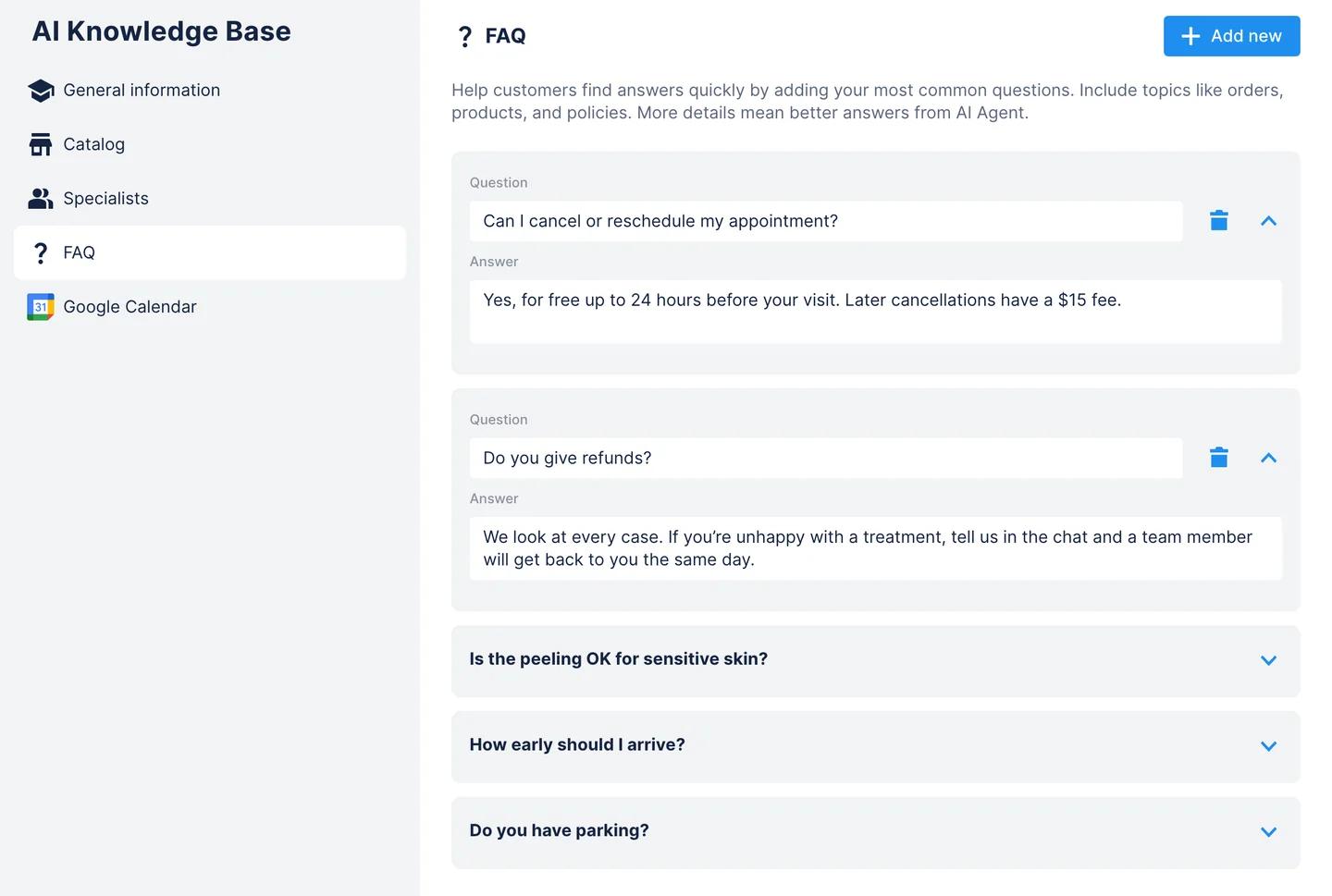
- Answers from your knowledge. The AI Agent replies from your AI Knowledge Base: business details, open hours, prices or catalog, and your FAQ. It also understands voice messages and answers them in text (voice messages).
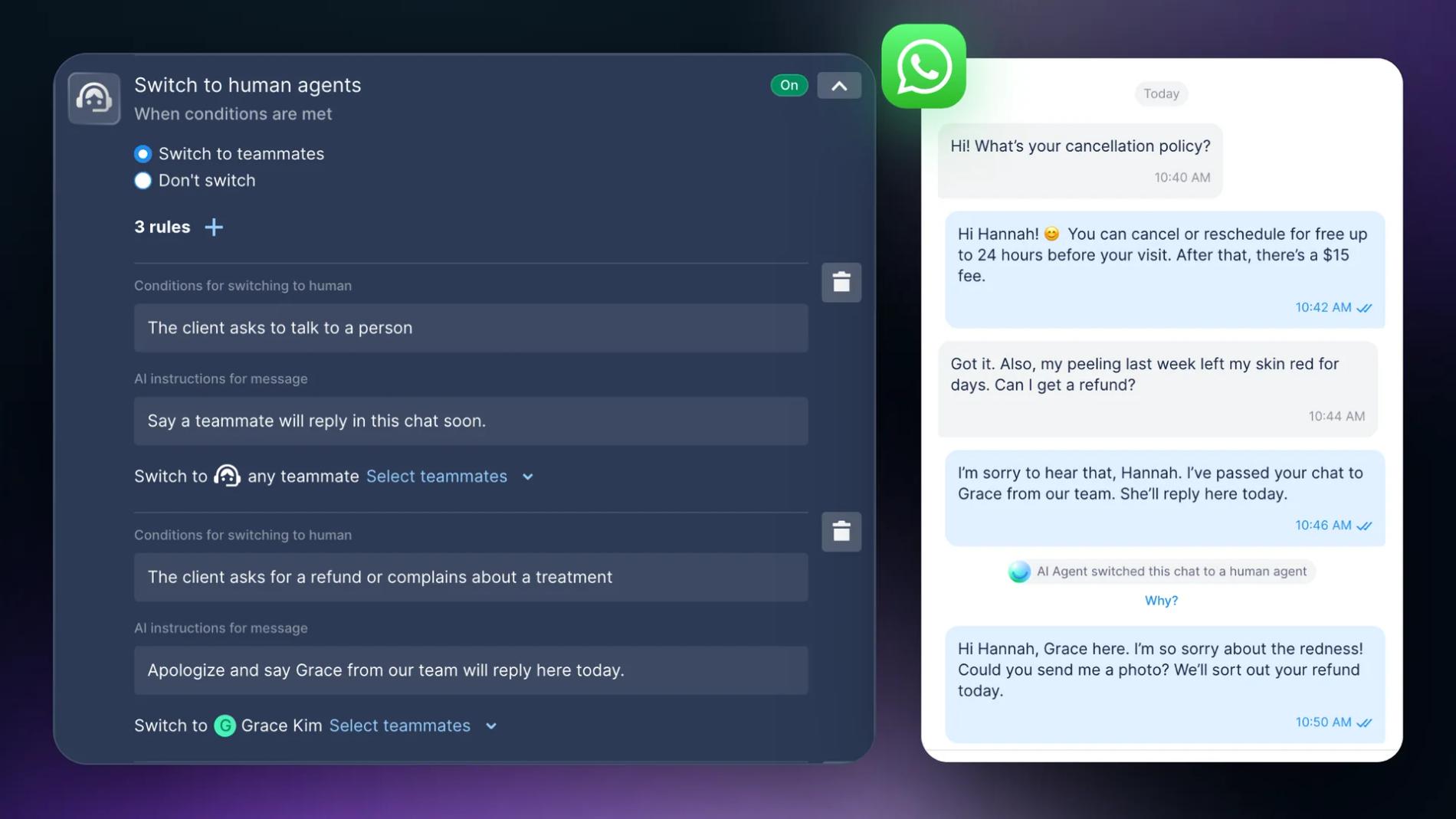
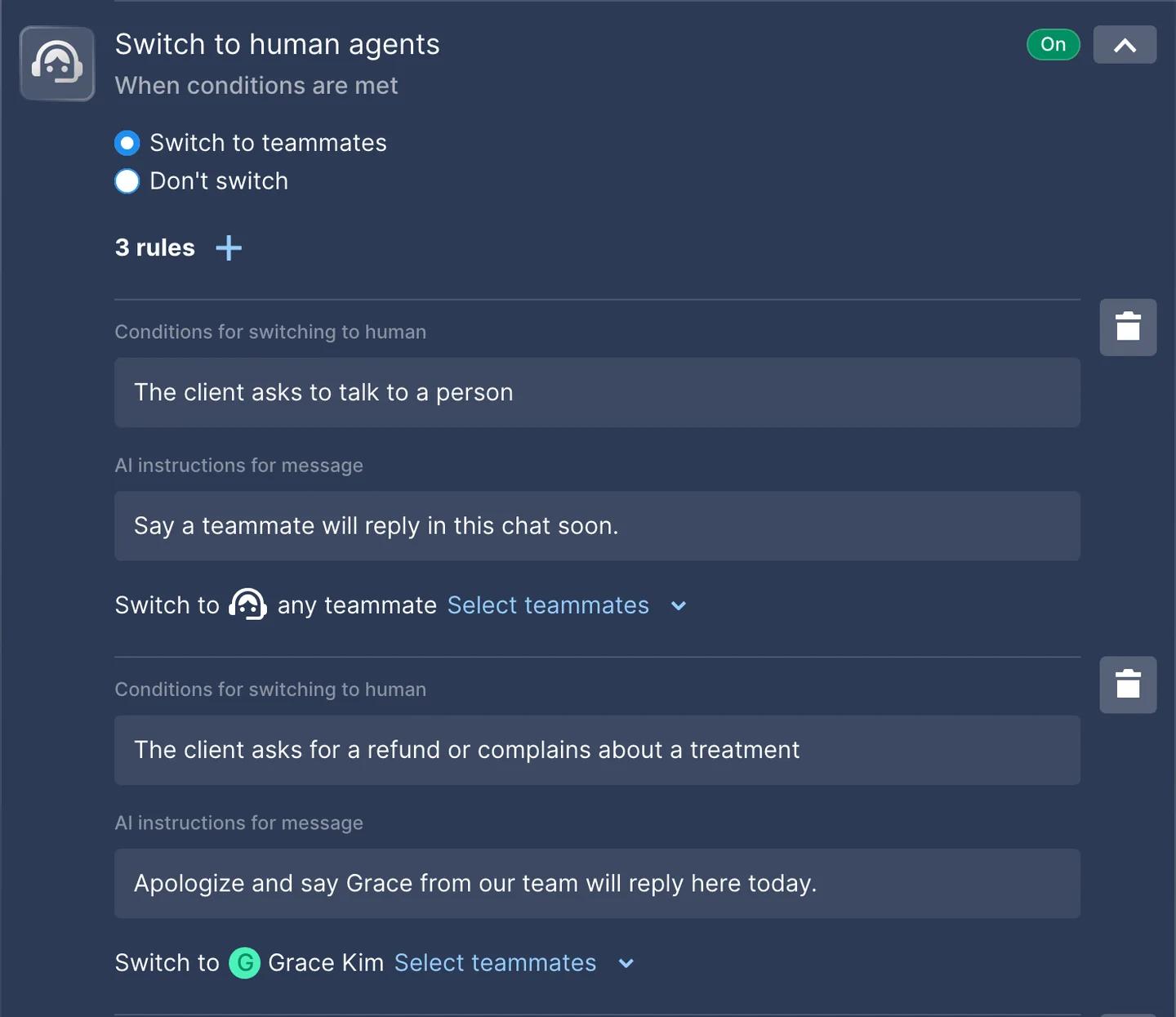
- Handoff with rules. In Switch to human agents, you describe when the AI should pass a chat to a person (for example, a refund request or a complaint) and who gets it: any teammate or a specific one. The AI Agent tells the customer that a teammate will reply, and the teammate sees the whole conversation.
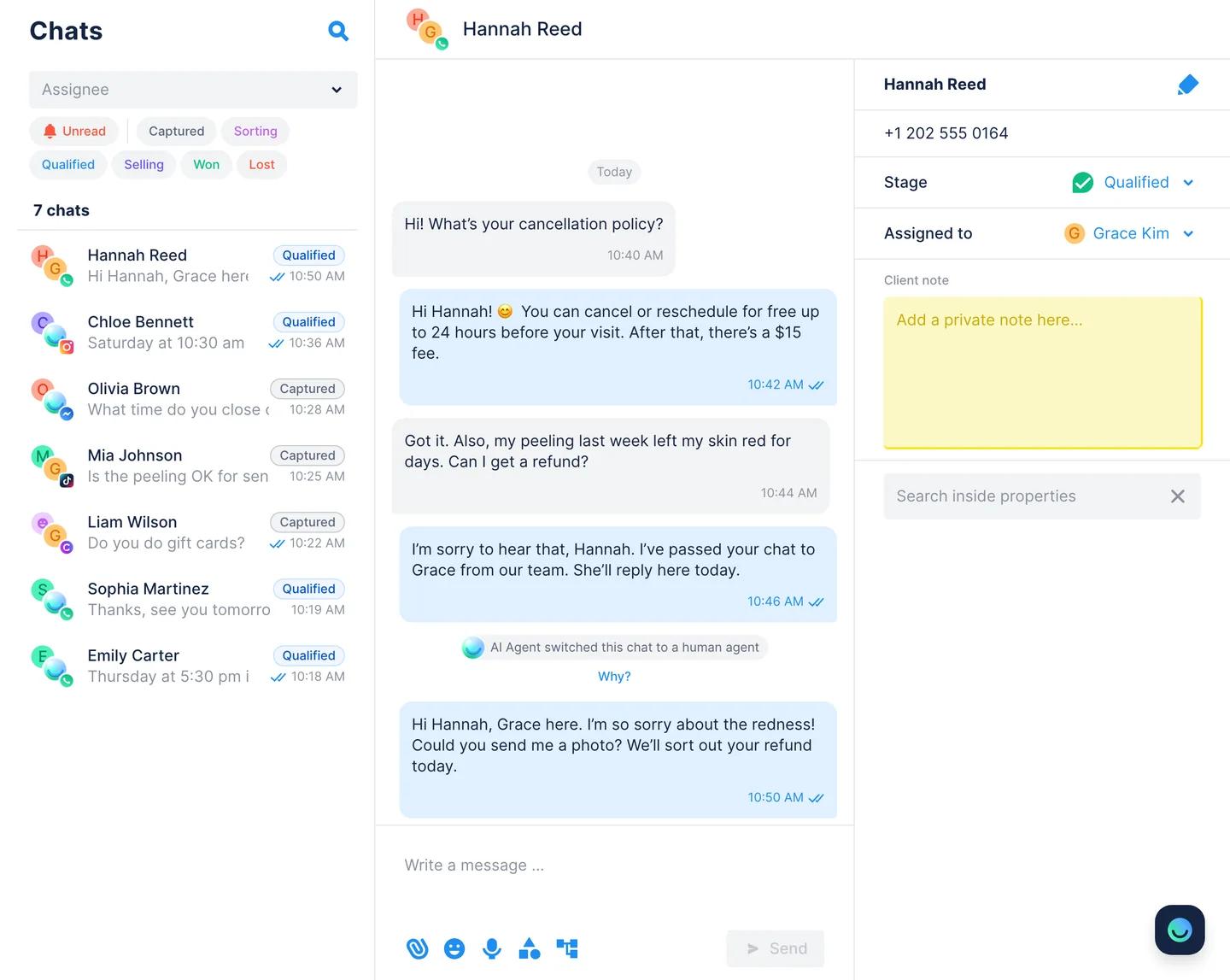
- One inbox for every channel. Chats lists conversations from all channels together, with filters such as Assigned to me and Unassigned. Comments on Instagram, Facebook and TikTok posts show up there as well.
- Replies on the go. Teammates answer from the browser or the Chatfuel mobile app and get push notifications about new chats.
- Working hours. In When AI replies, the AI Agent can answer always or only outside your working hours, while your team covers the day.
- Follow-ups and lead details. Send follow-ups reminds customers who went quiet (AI follow-ups), and Lead Qualification saves the contact details the customer shares to their card.
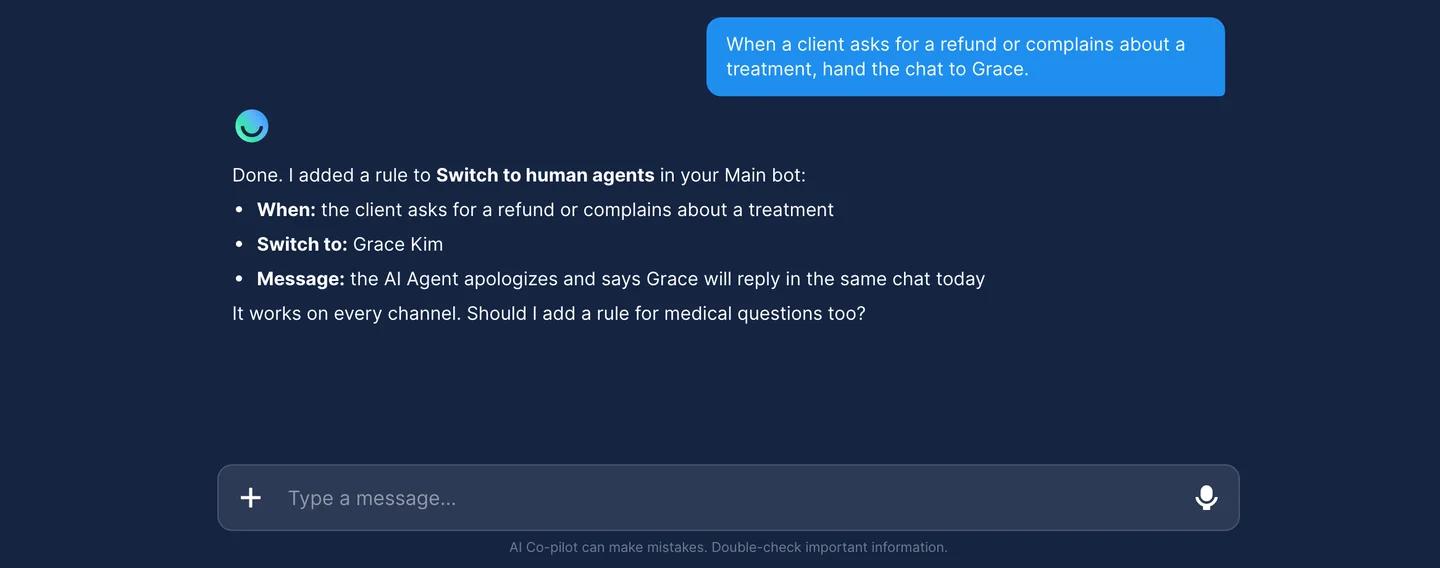
- AI Co-pilot. Set it all up by chatting: ask it to add an FAQ answer or a handoff rule, or to sum up what customers asked about this week.
Pricing: the Business plan costs $20 a month and includes $20 in credits for AI replies and messages. Agency plans for several client companies start at $100 a month, and yearly billing saves 10%. Every plan includes all channels, unlimited contacts and teammates, and no seat fees. Meta's WhatsApp message fees come out of the same credit wallet. Each plan starts with a 7-day free trial with $15 in credits. See Chatfuel pricing.
Results: HelloFresh built its Messenger support bot on Chatfuel and cut its average response time by 76%, from five hours to just over one, while messages grew by 47%. The fashion resale platform TheCultt automated its Instagram chats and raised conversion to purchase by 37%.
Best for: small and midsize businesses whose customers write in WhatsApp, Instagram, Messenger, TikTok or website chat.
Keep in mind: Chatfuel works in messaging channels only. It doesn't handle email tickets, SMS or phone calls.
2. Freshdesk
Freshdesk is Freshworks' help desk. It started as ticketing software and now comes in two versions: Freshdesk for email support and Freshdesk Omni, which adds chat, phone and messaging apps to the same agent workspace.
Channels: email, a support portal and a web widget in Freshdesk. Omni adds live chat, voice, WhatsApp, Facebook Messenger, Instagram and LINE.
AI: Freddy AI Agent answers customers. Each account gets 500 sessions once, then it costs $49 per 100 sessions. Freddy AI Copilot helps human agents for $29 per agent a month (annual), on Pro and Enterprise.
Pricing: Freshdesk Omni costs $29 (Growth), $79 (Pro) or $119 (Enterprise) per agent a month, billed annually. Email-only Freshdesk starts at $19. There's a 14-day free trial and no free plan.
Best for: support teams that run on tickets and want messaging in the same place.
Keep in mind: AI sessions are paid on top of seats, and messaging channels need the Omni plans.
3. Zendesk
Zendesk is a customer service platform built around tickets. Zendesk Suite combines ticketing, messaging and live chat, a help center and voice in one agent workspace, and every Suite plan includes AI agents.
Channels: email, web and in-app messaging, live chat, voice, SMS, and social and messaging apps such as Facebook, Instagram, X, WhatsApp, LINE, WeChat and Slack. Some channels have extra fees.
AI: AI agents answer in messaging and email. You pay per automated resolution: each plan includes 5 to 10 per agent a month, then $1.50 each on a commitment or $2.00 pay as you go. Copilot for human agents is a $50 add-on per agent.
Pricing: Support Team, the ticketing-only plan, costs $19 per agent a month with annual billing ($25 month to month). Suite Team costs $55 ($69) and Suite Professional $115 ($149). Enterprise is priced by sales. There's a 14-day free trial.
Best for: support teams with high ticket volumes, service levels to meet and several departments.
Keep in mind: per-agent prices plus per-resolution AI fees mean costs grow with both your team and your automation.
4. Kustomer
Kustomer is a customer service platform with a CRM at its core. Instead of separate tickets, it shows each customer as one timeline with every conversation, order and note, which suits large teams that handle many contacts per customer.
Channels: email, chat, SMS, voice, forms and Slack, plus WhatsApp, Instagram, Facebook and TikTok Shop.
AI: Concierge, the AI agent for customers, costs $0.75 per conversation it engages in. Envoy, the AI assistant for human agents, costs $50 per user a month.
Pricing: the current Enterprise and Ultimate plans are priced on request. Kustomer's per-conversation plans from earlier years are now listed as legacy.
Best for: enterprise support teams, often in retail, that want one view of the customer.
Keep in mind: there are no public prices, and the setup is a project, not an afternoon.
5. Intercom
Intercom is a customer service platform built around Fin, its AI agent. Fin answers customers first, and the Intercom help desk gives human agents an inbox, tickets and a help center for the rest.
Channels: web and in-app chat (the Intercom Messenger), email, phone, SMS, WhatsApp, Instagram, Facebook and Slack. WhatsApp and SMS are billed by usage.
AI: Fin costs $0.99 per outcome, charged at most once per conversation, and can also run on top of Zendesk or Salesforce. Copilot for human agents costs $29 per seat a month (annual).
Pricing: Essential costs $29 per seat a month with annual billing ($39 month to month), Advanced $85 ($99) and Expert $132 ($139). There's a 14-day free trial.
Best for: SaaS and online products that support customers inside their app.
Keep in mind: seats and Fin outcomes are billed separately, so the bill grows with both your team and the AI's work.
6. Help Scout
Help Scout is a help desk that looks and works like a shared email inbox. Teams that answer most questions by email like it for its simple interface, collision detection and saved replies.
Channels: email, live chat on your website, SMS, WhatsApp, Instagram and Facebook Messenger. Phone works only through integrations such as Aircall.
AI: AI Answers replies to customers from your help center for $0.75 per resolution, with a monthly cap you set. AI drafts, summaries and tone editing for agents are included.
Pricing: a free plan for up to 5 users, 1 inbox and 100 contacts a month. Paid plans cost $25 (Standard), $45 (Plus) and $75 (Pro) per user a month, with unlimited contacts. There's a 15-day free trial.
Best for: small teams whose support runs mostly on email.
Keep in mind: messaging apps are secondary, and AI is paid per resolution on top of seats.
7. Zoho Desk
Zoho Desk is the help desk in the Zoho suite. It handles tickets from email, chat, social media and phone, and it's one of the cheapest full help desks on this list.
Channels: email on every plan; a chat widget, WhatsApp, Instagram, Messenger, Telegram, WeChat and LINE from Standard; phone from Professional.
AI: Zia tags tickets, suggests answers and reads customer sentiment from the Professional plan. AI agents for customers are available from Express and can use Zoho's model or your own AI account.
Pricing: a free plan for 3 users with email tickets. Paid plans cost $7 (Express), $14 (Standard), $23 (Professional) and $40 (Enterprise) per user a month, billed annually. There's a 15-day free trial.
Best for: small businesses on a budget, especially those already using Zoho CRM.
Keep in mind: the interface is busy, and the useful AI starts on the higher plans.
8. Tidio
Tidio combines live chat for websites with Lyro, its AI agent. It's popular with small online stores that want a chat widget, simple automations and AI in one tool.
Channels: live chat on your website, email, Facebook Messenger, Instagram and WhatsApp.
AI: Lyro answers from your FAQ and website content. It starts at $39 a month ($32.50 billed annually) for 50 conversations, and you can buy it on its own.
Pricing: a free plan with 50 conversations. Starter costs $29 a month ($24.17 billed annually) for 100 conversations, Growth from $59 a month, Plus from $300 a month, and Premium is priced on request. Tidio counts conversations a human agent replies to, not seats. There's a 7-day free trial.
Best for: small e-commerce stores that start from website chat.
Keep in mind: costs grow with conversation volume, and Lyro is priced separately from the chat plans.
9. LiveAgent
LiveAgent is a help desk with a universal inbox and a built-in call center. Emails, chats, calls and social messages all arrive as tickets in one stream.
Channels: email, live chat, phone and video calls (from Team), Facebook, Messenger, Instagram, X, Viber, Telegram and WhatsApp (through Twilio or 360dialog).
AI: every plan includes AI agents, from one on Starter to unlimited on Enterprise. They run on your own AI provider account, so LiveAgent charges no per-resolution fees.
Pricing: Starter costs $19 per agent a month ($15 billed annually), Team $35 ($29) and Business $59 ($49). Enterprise is a flat $3,999 a month for up to 80 agents. There's a 30-day free trial.
Best for: small and midsize teams that answer both chats and phone calls.
Keep in mind: WhatsApp needs a third-party provider, and you have to set up and pay for the AI account yourself.
10. Respond.io
Respond.io is a customer conversation platform for teams that sell and support on messaging apps. It brings WhatsApp, Instagram, Messenger, TikTok, Telegram, LINE, email and other channels into one team inbox, with workflows and AI agents on top.
Channels: WhatsApp (including calls), Instagram, Facebook Messenger, TikTok, Telegram, LINE, Viber, WeChat, email and website chat.
AI: AI agents answer, qualify and route conversations from the Growth plan. Each plan includes AI credits; extra credits cost $15 per 1,000.
Pricing: priced by the contacts you talk to each month. Starter costs $79 a month, Growth $159 and Advanced $279, billed yearly; extra users cost $12 to $24 a month. WhatsApp fees are extra. There's a 7-day free trial.
Best for: midsize sales and support teams with several people per channel and a process to follow.
Keep in mind: for a single owner or a small team, it's more tool than needed.
Why automate customer support
- Answers at any hour. An AI agent replies in seconds at night, on weekends and on holidays, when your team is offline.
- Your team works on the hard cases. Routine questions about prices, open hours or policies get answered automatically, and people take refunds, complaints and anything sensitive.
- The same answer every time. Answers come from one knowledge base, so every customer hears the same policy.
- Peaks don't need extra hires. A sale, a holiday or a viral post can double your messages; the AI handles the extra volume.
- Customers stay in their app. When support works in WhatsApp or Instagram, customers don't have to switch to email or wait on the phone.
- You learn what customers ask. The questions that come up most show what to add to your FAQ, your website or your product.
How to choose a customer support automation tool
Start with where your customers write
List the channels customers use to reach you today. If most of them message you on WhatsApp, Instagram or TikTok, a messaging-first tool like Chatfuel or Respond.io covers them out of the box. If email tickets and phone calls dominate, a help desk like Zendesk, Freshdesk or Help Scout fits better.
Check the handoff to people
AI should know when to stop. See how a chat reaches a person: who decides, who gets it, and whether the teammate sees the full conversation. In Chatfuel, Switch to human agents rules decide when to hand off and to whom, and the teammate replies in the same chat.
Look at what the AI answers from
An AI agent is only as good as what you give it. Check where it takes answers from (a FAQ, a knowledge base, help center articles) and how easy that is to update. In Chatfuel, that's the AI Knowledge Base, and AI Co-pilot can add an answer for you.
Compare the pricing model, not only the price
- Plan with credits (Chatfuel): a fixed monthly plan whose credits pay for AI replies and Meta's WhatsApp fees, with unlimited teammates.
- Per seat (Zendesk, Freshdesk, Intercom, Help Scout, Zoho Desk, LiveAgent): the cost grows with your team.
- Per AI resolution or conversation (Zendesk, Intercom, Kustomer, Help Scout): the cost grows with your automation.
- Per contact or conversation volume (Respond.io, Tidio): the cost grows with your customers.
Count the setup effort
No-code tools like Chatfuel, Tidio and Help Scout can start working the same day. Zendesk, Kustomer and Freshdesk Omni take longer to configure for larger teams.
Try it on real questions
Use the free trial with your own FAQ and a few real customer questions before you decide. Every tool on this list has a trial or a free plan.
How to automate customer support with Chatfuel
- Start the trial. Pick a plan on the pricing page and start the 7-day free trial.
- Connect your channels. In Settings, connect WhatsApp, Instagram, Facebook, TikTok or your website.
- Fill in the AI Knowledge Base. Add your business details and Open hours, your prices or catalog, and a FAQ with your policies: cancellations, delivery, refunds. The AI Agent answers from it on every channel.
- Turn on the AI Agent. In Automations, keep Default on and switch on the channels where the AI Agent should reply. In When AI replies, choose whether it answers always or only outside working hours.
- Set up the handoff. Open Switch to human agents, choose Switch to teammates and add rules: when a chat goes to a person, what the AI Agent tells the customer, and which teammate gets it.
- Invite your team. Add teammates in Settings and give each one a role. They answer in Chats in the browser or in the mobile app.
- Review and improve. Ask AI Co-pilot what customers asked most this week, and add the missing answers to your FAQ.
AI Co-pilot can do most of these steps for you: ask it in plain words to add an FAQ answer, turn the AI Agent on for a channel or add a handoff rule. Only connecting a channel needs you to finish the login yourself. See how it works on the customer support page.
See also: How Much Does a Chatbot Cost? Build vs. Buy
Summary
- Chatfuel fits when your customers write in WhatsApp, Instagram, Messenger, TikTok or website chat, and you want an AI Agent to answer first with your team behind it.
- Zendesk, Freshdesk and Kustomer fit large support teams that run on tickets, email and phone.
- Intercom fits SaaS and online products, with Fin as the AI agent.
- Help Scout and Zoho Desk are affordable help desks for small teams that work mostly in email.
- Tidio fits small online stores that start from website chat.
- LiveAgent fits teams that answer phone calls next to chats.
- Respond.io fits midsize teams that sell and support on many messaging apps.
FAQs
What is the best tool for automated customer service?
It depends on where your customers write. If they message you on WhatsApp, Instagram, Messenger, TikTok or your website, Chatfuel's AI Agent answers them there and hands the hard cases to your team. If most of your support runs on email tickets and phone calls, look at a help desk such as Zendesk or Freshdesk.
How much do customer support automation tools cost?
Chatfuel costs $20 a month with $20 in credits and unlimited teammates. Help desks charge per agent: Zendesk from $19, Freshdesk Omni from $29 and Intercom from $29 per seat a month, plus AI fees per resolution or session. Help Scout, Zoho Desk and Tidio have free plans with limits.
Can AI replace human support agents?
Not fully, and it shouldn't. AI handles the repetitive questions well: prices, open hours, policies and booking questions from your knowledge base. Refunds, complaints and sensitive topics should go to a person. In Chatfuel, you decide which chats those are with Switch to human agents rules.
Which channels does Chatfuel support?
Five: WhatsApp, Instagram, Facebook Messenger, TikTok and a chat widget for your website. Comments on Instagram, Facebook and TikTok posts are covered too. Email, SMS and phone calls aren't supported.
Does Chatfuel have a free plan?
No. Every Chatfuel plan starts with a 7-day free trial with $15 in credits and every channel included. You add a card to start, and nothing is charged during the trial. After that, the Business plan costs $20 a month.
