
 Ion Rotaru
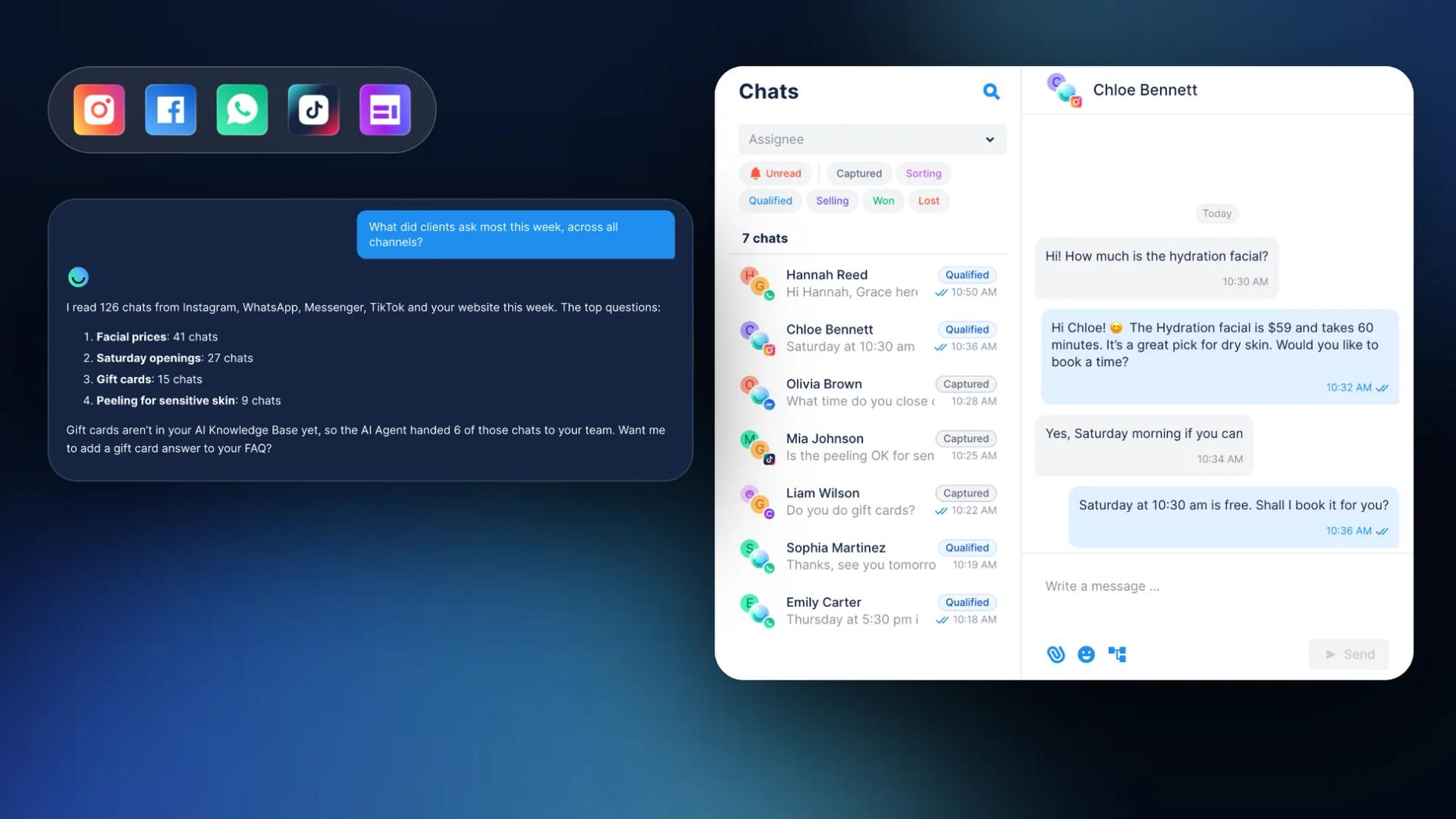
Most of what customers ask is the same few questions about prices, open hours, delivery or a free slot, sent at any hour from WhatsApp, Instagram or a website chat. A conversational AI platform answers them for you: an AI agent understands what people write, replies from your business information and hands the hard cases to your team.
Platforms differ a lot, though. Some are ready to use and connect to WhatsApp or Instagram in an afternoon. Others are developer frameworks from cloud providers that you build on for months. We compared 9 of them on channels, AI, who they fit and price:
- Chatfuel: an AI Agent for WhatsApp, Instagram, Messenger, TikTok and website chat, with your team behind it
- LivePerson: an enterprise conversational cloud, now part of SoundHound AI
- Intercom Fin: an AI agent for support teams, priced per resolved conversation
- Jio Haptik: AI agents for large retail, finance and telecom brands
- Yellow.ai: an agentic platform for enterprise support and HR
- Amazon Lex: AWS's service for building chat and voice bots
- Oracle Digital Assistant: digital assistants for Oracle cloud apps
- Google CX Agent Studio: Google's agent builder, formerly Dialogflow
- IBM watsonx Orchestrate: IBM's agent platform, which replaced Watson Assistant
See also: Customer support automation: choosing the right tools
What is a conversational AI platform?
A conversational AI platform is software that lets a business run an AI agent that talks to customers in natural language, by text or voice. The agent understands the question, finds the answer in your business information and replies, or passes the conversation to a person.
Older platforms worked with intents: you listed the phrases a customer might type, and the bot matched them to a scripted answer. Today most platforms run on large language models, so the agent understands questions it was never trained on and answers in your customer's language. You give it knowledge (prices, policies, a FAQ) and rules (when to hand a chat to your team) instead of scripts.
The platforms in this list come in two types:
- Ready-to-use platforms (Chatfuel, LivePerson, Intercom Fin, Jio Haptik, Yellow.ai). You connect your channels, add your business information and turn the AI agent on. No code is needed.
- Developer frameworks (Amazon Lex, Oracle Digital Assistant, Google CX Agent Studio, IBM watsonx Orchestrate). You build the agent yourself on a cloud platform, connect it to your systems and run it. They fit companies with their own engineering team.
Conversational AI platforms compared
| Tool | Type | Channels | Price from |
|---|---|---|---|
| Chatfuel | Ready to use | WhatsApp, Instagram, Messenger, TikTok, website chat | $20 a month with $20 in credits |
| LivePerson | Ready to use, enterprise | Web, apps, SMS, WhatsApp, Messenger, Instagram, Apple Messages, voice and more | On request |
| Intercom Fin | Ready to use | Website and app chat, email, phone, WhatsApp, Instagram, Messenger, SMS | $0.99 per outcome + $29 per seat a month |
| Jio Haptik | Ready to use, enterprise | WhatsApp, Instagram, Messenger, RCS, web, voice | On request |
| Yellow.ai | Ready to use, enterprise | Web, WhatsApp, Instagram, Messenger, SMS, email, voice and more | Free plan, then $0.99 per resolution |
| Amazon Lex | Developer framework | Voice, web and apps, Facebook, Slack, Twilio | $0.00075 per text request |
| Oracle Digital Assistant | Developer framework | Web and apps, Messenger, Slack, Teams, SMS | About $5.80 an hour |
| Google CX Agent Studio | Developer framework | Web, phone, Messenger, Slack, LINE, Google Chat | $0.50 per session |
| IBM watsonx Orchestrate | Developer framework | Web chat, voice, Slack, Teams | $530 a month |
Prices as listed on each vendor's website in October 2026. Per-request and per-session prices grow with your volume.
9 best conversational AI platforms
1. Chatfuel
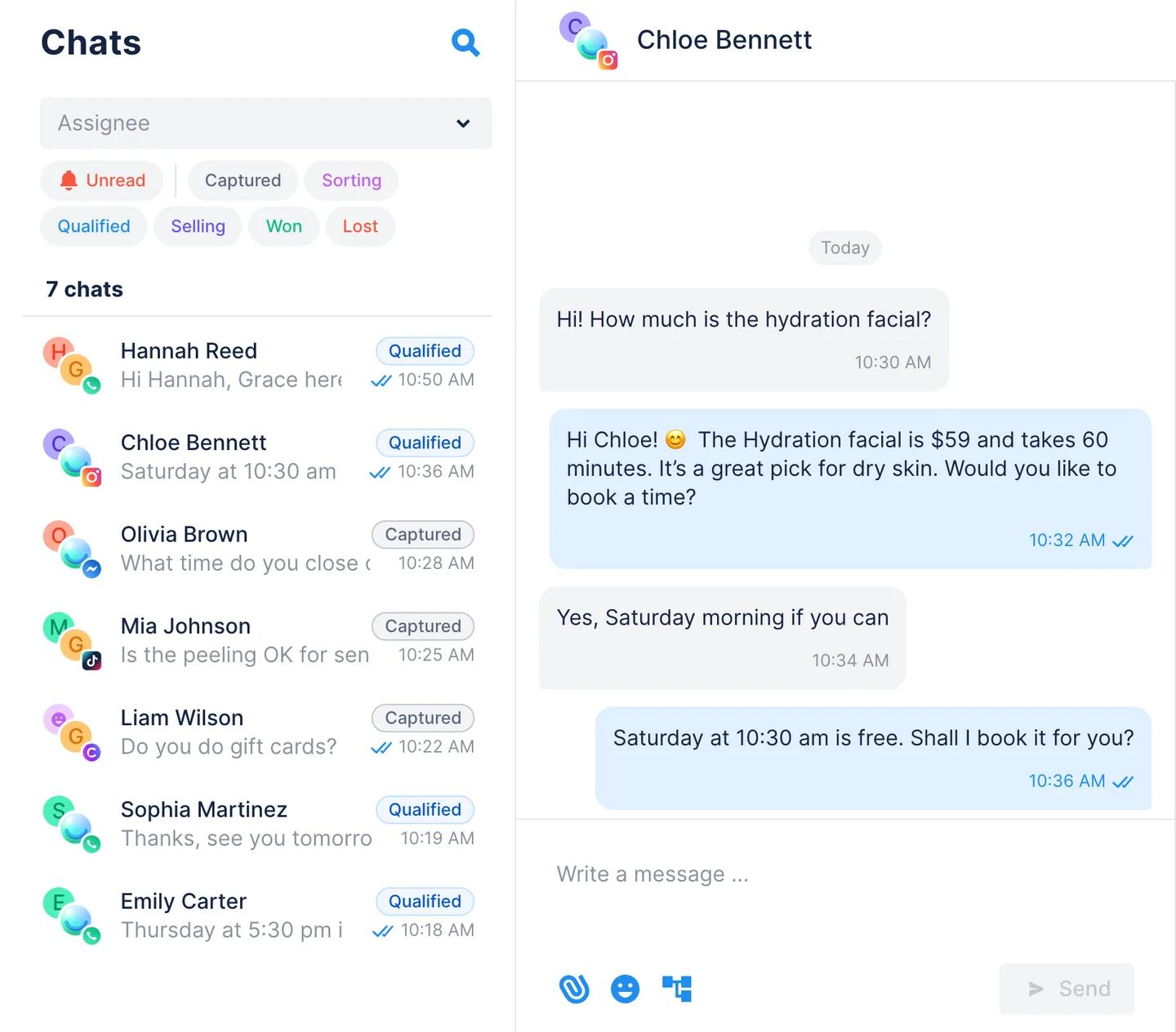
Chatfuel is an AI agent platform for messaging channels and an official Meta partner. It connects WhatsApp through the official WhatsApp Business Platform, Instagram, Facebook Messenger, TikTok and a chat widget for your website. The AI Agent answers customers on all of them around the clock, books appointments, recommends products and hands a chat to your team when a person should take over.
What you get:
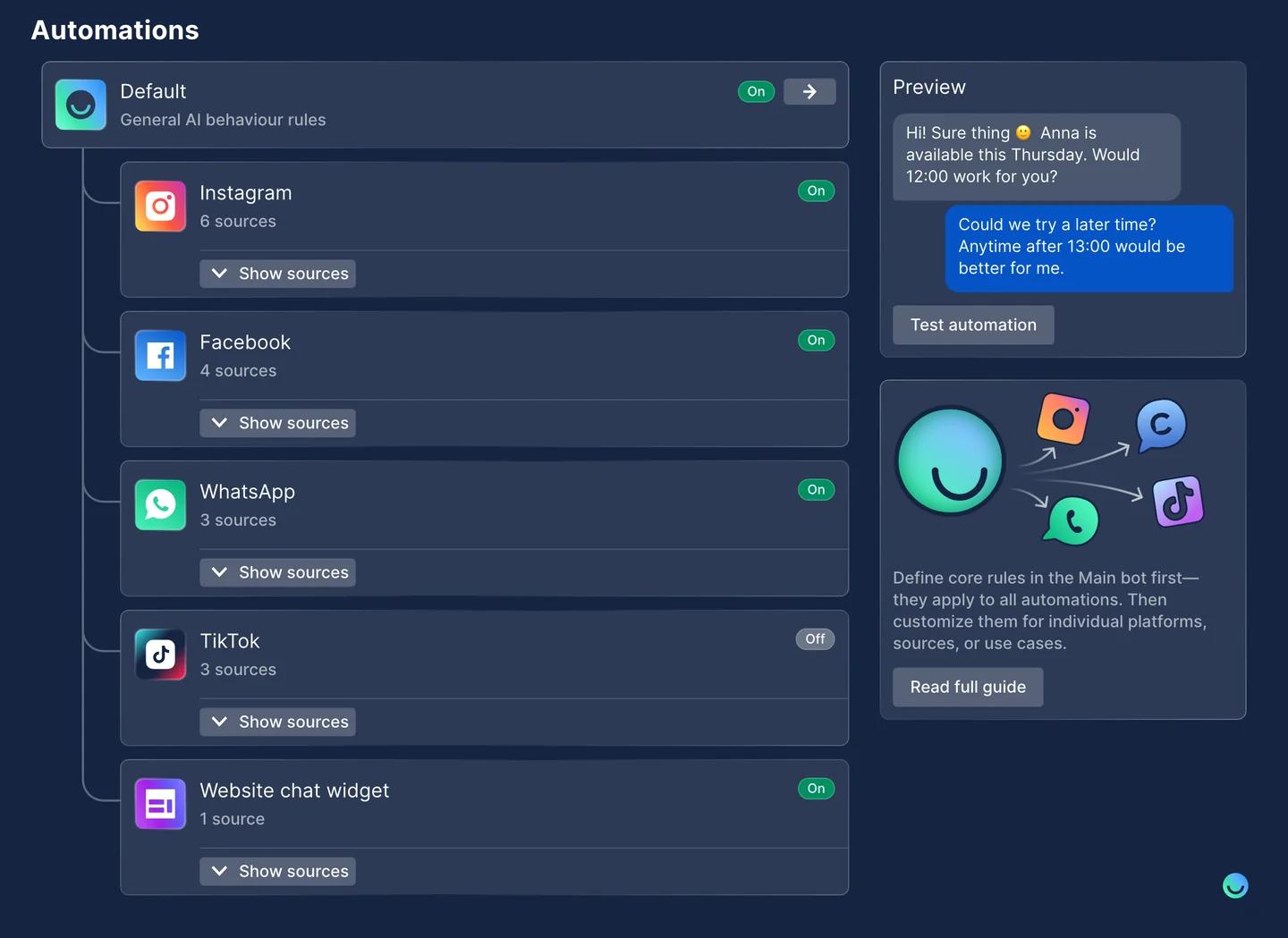
- One AI Agent for every channel. In Automations, the Default settings apply everywhere, and each channel (WhatsApp, Instagram, Facebook, TikTok, website) can have its own. Comments on Instagram, Facebook and TikTok posts get replies too.
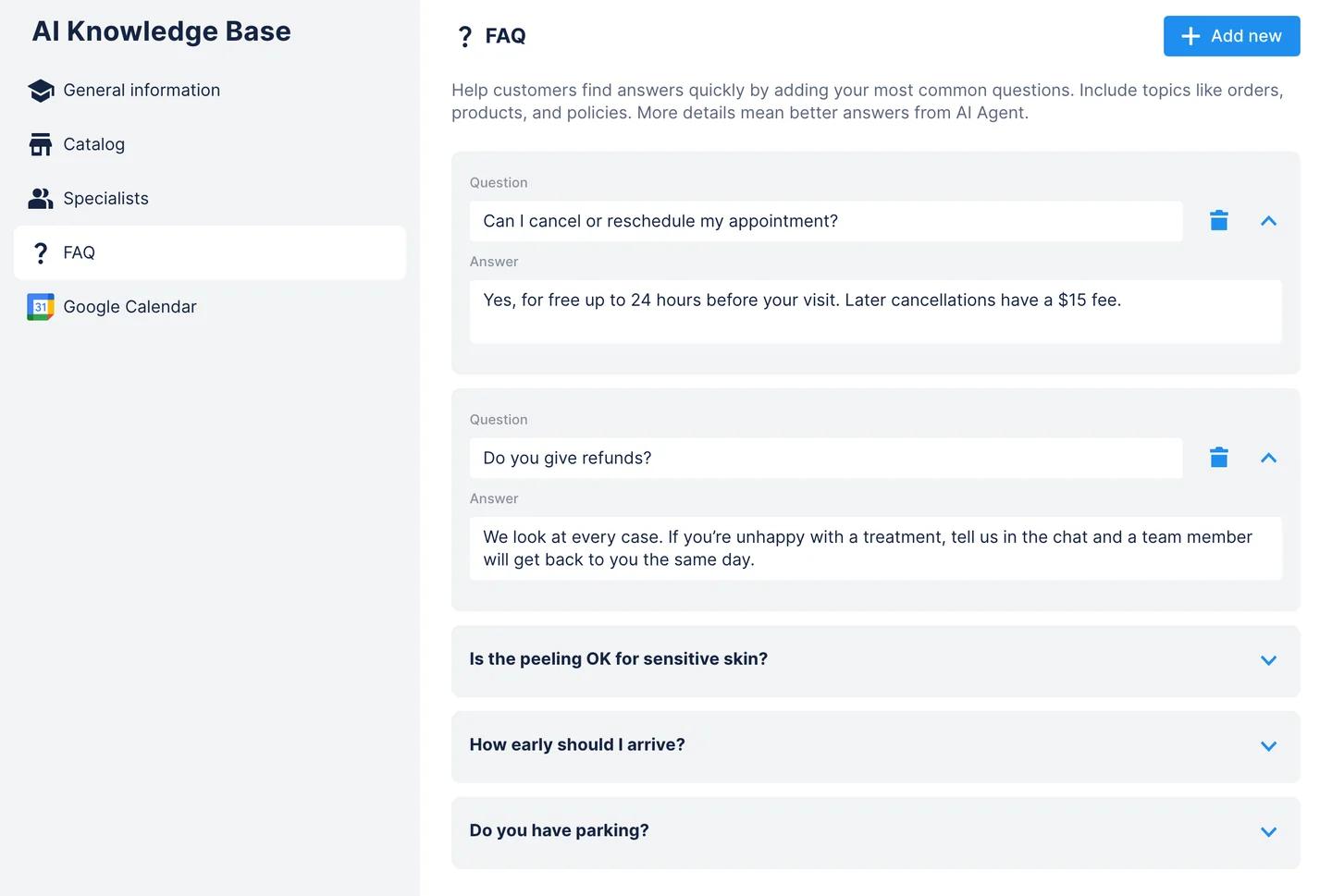
- Answers from your knowledge. The AI Agent replies from your AI Knowledge Base: business details, open hours, your catalog with prices and photos, and your FAQ. It understands voice messages and answers them in text (voice messages).
- Bookings and leads. It offers free slots and books appointments in the Calendar (booking). Lead Qualification saves the contact details customers share to their card, and Send follow-ups reminds people who went quiet (AI follow-ups).
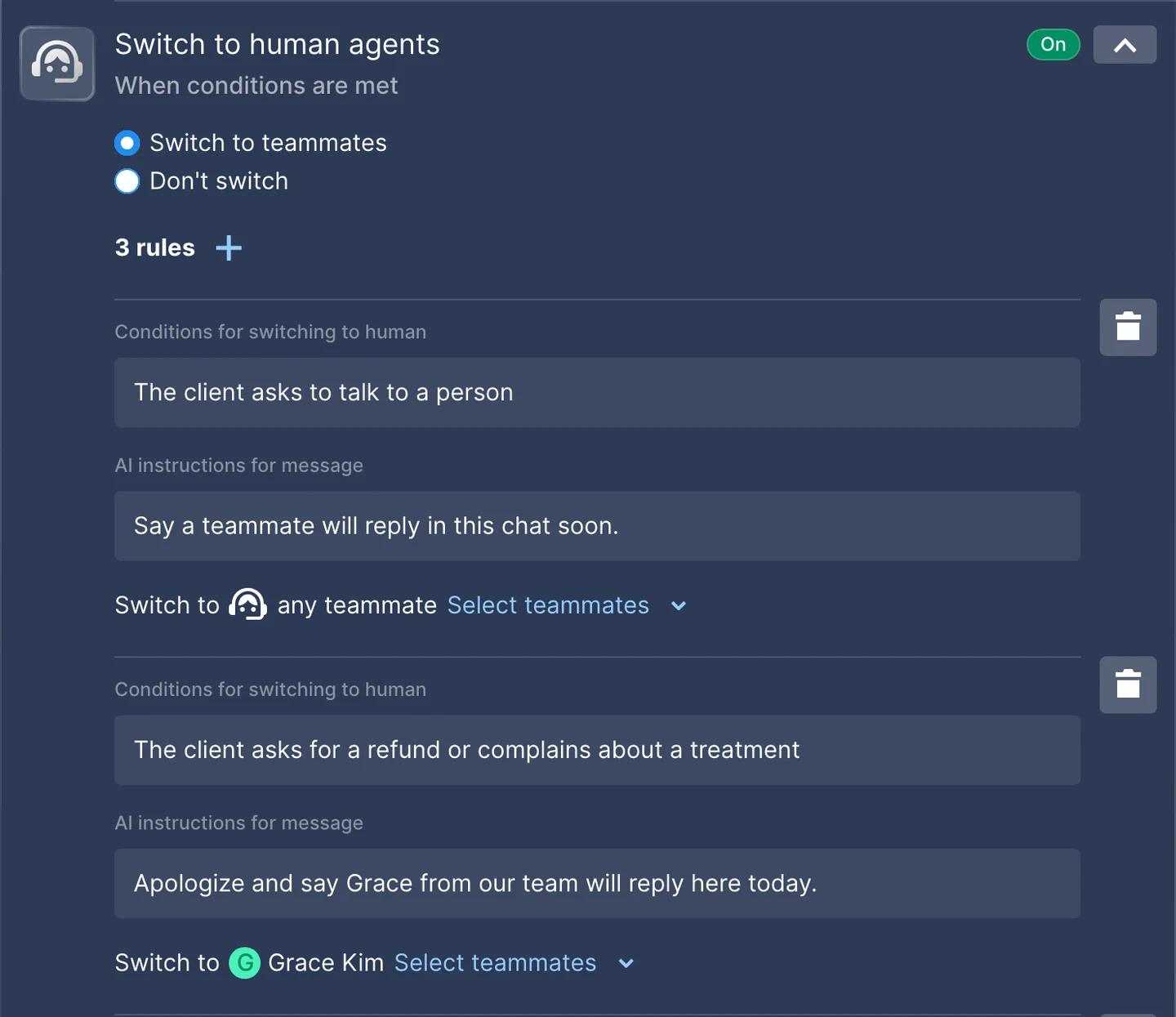
- Handoff with rules. In Switch to human agents, you describe when a chat should go to a person and who gets it. Your team replies in Chats in the browser or the mobile app.
- AI Co-pilot. Set things up by chatting: ask it to add an FAQ answer, turn the AI Agent on for a channel or sum up what customers asked this week. You can also manage Chatfuel from Claude, ChatGPT or Cursor through the Chatfuel MCP server.
Pricing: the Business plan costs $20 a month and includes $20 in credits for AI replies and messages. Agency plans for several client companies start at $100 a month, and yearly billing saves 10%. Every plan includes all channels, unlimited contacts and teammates, and no seat fees. Meta's WhatsApp message fees come out of the same credit wallet. Each plan starts with a 7-day free trial with $15 in credits. See Chatfuel pricing.
Results: HelloFresh built its Messenger support bot on Chatfuel and cut its average response time by 76%. The fashion resale platform TheCultt automated its Instagram chats and raised conversion to purchase by 37%.
Best for: small and midsize businesses whose customers write in WhatsApp, Instagram, Messenger, TikTok or website chat, and who want the AI agent live the same day without developers.
Keep in mind: Chatfuel works in messaging channels only. It doesn't handle email tickets, SMS or phone calls.
2. LivePerson
LivePerson's Conversational Cloud is one of the oldest enterprise messaging platforms. SoundHound AI completed its acquisition of LivePerson on September 4, 2026, and plans to combine it with its own voice and agent technology.
Channels: web and in-app messaging, SMS, WhatsApp, Messenger, Instagram, Apple Messages for Business, Google RCS, LINE, Viber, WeChat, Kakao Talk and email, plus voice.
AI: generative AI agents that answer from a knowledge base and route conversations, Copilot tools for human agents, a no-code Conversation Builder and the option to bring your own LLM.
Pricing: LivePerson doesn't publish prices; packages are quoted by sales. Outbound SMS and WhatsApp messages are charged at the provider's rates plus a 15% handling fee.
Best for: large brands with contact centers that need messaging across many channels and countries.
Keep in mind: there's no self-serve plan, and the product roadmap may change as it moves into SoundHound.
See also: 10 best LivePerson alternatives for support
3. Intercom Fin
Intercom is a customer service platform built around Fin, its AI agent. Fin answers from your help center and other content, and can also work on top of another help desk such as Zendesk or Salesforce.
Channels: the Intercom Messenger on your website and app, email, phone (Fin Voice), WhatsApp, Instagram, Facebook Messenger, SMS and Slack.
AI: Fin AI Agent resolves conversations on its own and hands them to your team in the shared inbox. Copilot helps human agents for $29 per agent a month, billed annually.
Pricing: Fin costs $0.99 per outcome, on top of a seat plan: Essential $29, Advanced $85 or Expert $132 per seat a month, billed annually. WhatsApp, SMS and phone are charged by usage. There's a 14-day free trial.
Best for: SaaS and online products with a support team that works in chat and email.
Keep in mind: the bill grows with both your team (seats) and your AI volume (outcomes), and messaging channels add usage fees.
4. Jio Haptik
Haptik, now Jio Haptik, has built conversational AI for enterprises for over a decade, mostly for retail, travel, fintech and telecom brands in India. Its platform now runs LLM-driven AI agents.
Channels: WhatsApp, Instagram Direct, Facebook Messenger, RCS Business Messaging, website chat and voice AI agents.
AI: AI agents for customer service, sales and marketing, with a choice of models (GPT, Llama or Claude) and an agent inbox for your team.
Pricing: custom, after a demo; there are no public plans.
Best for: large consumer brands, especially in India, that sell and support on WhatsApp.
Keep in mind: it's built for enterprise projects, so expect a sales process and onboarding rather than a self-serve start.
5. Yellow.ai
Yellow.ai sells Nexus, an "agentic" platform for customer service and employee support, with separate products for voice (Nexus VOX) and desktop work.
Channels: website chat, WhatsApp, Instagram, Messenger, Telegram, SMS, LINE, Viber, Teams, Slack, email and voice: over 35 channels on the Enterprise plan.
AI: AI agents built with AI Agent Builder on more than 15 LLMs, a knowledge base that answers from your documents, and no-code and pro-code tools.
Pricing: a free plan with one AI agent and 500 chat sessions a month, then $0.99 per resolution. Enterprise pricing is on request.
Best for: large companies that automate support and HR in many languages and channels.
Keep in mind: the free plan is limited, and most features and channels sit on the Enterprise plan.
6. Amazon Lex
Amazon Lex is the AWS service for building chat and voice bots, and the engine behind many Amazon Connect contact centers. Unlike the platforms above, it's a tool for developers.
Channels: voice and chat through Amazon Connect, your own web and mobile apps through the SDK, and built-in connectors for Facebook, Slack and Twilio SMS.
AI: intent-based bots with speech recognition, plus generative features through Amazon Bedrock: answers from your documents (QnAIntent), help with filling in details and generated training phrases.
Pricing: $0.00075 per text request and $0.004 per speech request; streaming conversations cost more. New AWS customers get up to $200 in AWS Free Tier credits.
Best for: companies on AWS that build voice and chat bots for their contact center.
Keep in mind: you need developers to build, connect and maintain the bot, and there's no native WhatsApp or Instagram connector.
7. Oracle Digital Assistant
Oracle Digital Assistant lets you build assistants from "skills": prebuilt ones for Oracle's ERP, HCM and CX apps, or your own. It's still sold, but Oracle recommends that Fusion Applications customers move to Oracle AI Agent Studio.
Channels: Oracle's web, iOS and Android SDKs, Facebook Messenger, Slack, Microsoft Teams, Twilio SMS, Apple Messages for Business and webhooks.
AI: intent-based skills and dialog flows, with a component that calls large language models through OCI Generative AI.
Pricing: $0.0232 per unit of "requests per hour", with a minimum of 250 per account (about $5.80 an hour), pay as you go.
Best for: companies that run Oracle cloud applications and want an assistant for employees or customers inside them.
Keep in mind: it's a developer platform tied to Oracle's cloud, and the Fusion templates are being retired in favor of AI Agent Studio.
8. Google CX Agent Studio
Google renamed Dialogflow: its agent builder is now called Customer Experience Agent Studio (CX Agent Studio), part of Gemini Enterprise for Customer Experience. Dialogflow CX lives on as Conversational Agents.
Channels: a web chat widget, a phone gateway, Messenger from Meta, Slack, LINE and Google Chat, plus phone systems from partners such as Avaya and Twilio. There's no native WhatsApp or Instagram connector.
AI: Gemini-powered agents built in a low-code visual builder, with generative "playbooks" next to scripted "flows" and templates to start from.
Pricing: CX Agent Studio costs $0.50 per chat or voice session ($0.45 or $0.40 with a 1- or 3-year commitment). On Conversational Agents, a chat request costs $0.007 with flows or $0.012 with playbooks, and new users get $600 or $1,000 in trial credits.
Best for: development teams on Google Cloud, and contact centers that automate voice calls.
Keep in mind: it's priced per session or request, so costs rise with every conversation, and messaging apps need custom connectors.
9. IBM watsonx Orchestrate
IBM Watson Assistant no longer has its own product page: it redirects to watsonx Orchestrate, IBM's platform for building and managing AI agents across a company.
Channels: web chat, voice, Slack and Microsoft Teams; WhatsApp, SMS and Messenger through Twilio and other connectors in the developer kit.
AI: LLM-based agents and multi-agent workflows, built in a no-code builder or with the Agent Development Kit.
Pricing: Essentials starts at $530 a month (up to 4,000 monthly active users) and Standard at $6,360 a month; Premium is on request. IBM says prices may vary by country. There's a 30-day free trial.
Best for: large enterprises that want AI agents for many departments, not only customer chat.
Keep in mind: it's a broad enterprise platform with a starting price to match, more than a small business needs for answering customers.
How to choose a conversational AI platform
Start with your customers' channels
List where your customers write today. If it's WhatsApp, Instagram, Messenger or TikTok, pick a platform that connects to them natively. Most developer frameworks don't, and building those connectors yourself is a project of its own.
Decide whether you build or connect
Ready-to-use platforms like Chatfuel, Intercom Fin and Yellow.ai work after a setup of hours or days. Frameworks like Amazon Lex, Google CX Agent Studio and watsonx Orchestrate give you more control, but you need developers to build the agent and keep it running.
Compare the pricing model, not only the price
- Plan with credits (Chatfuel): a fixed monthly plan whose credits pay for AI replies and Meta's WhatsApp fees, with unlimited teammates.
- Per seat plus per outcome (Intercom): the cost grows with your team and your AI volume.
- Per resolution, session or request (Yellow.ai, Google, Amazon Lex, Oracle): the cost grows with every conversation.
- Custom contracts (LivePerson, Jio Haptik, watsonx Orchestrate Premium): priced by sales for large volumes.
Check how it hands chats to people
AI should answer the routine questions, and people should take refunds, complaints and anything sensitive. Check that you can set those rules yourself and that your team sees the whole conversation when it takes over.
Look at where the answers come from
An AI agent is only as good as the information you give it. Check how you add and update it: a FAQ, a catalog, documents. In Chatfuel, that's the AI Knowledge Base, and AI Co-pilot can add answers for you.
Try it on real questions
Use the free trial with your own FAQ and a handful of real customer questions before you decide.
How to launch a conversational AI agent with Chatfuel
- Start the trial. Pick a plan on the pricing page and start the 7-day free trial.
- Connect your channels. In Settings, connect WhatsApp, Instagram, Facebook, TikTok or your website.
- Fill in the AI Knowledge Base. Add your business details and Open hours, your catalog with prices, and a FAQ with your policies. The AI Agent answers from it on every channel.
- Turn on the AI Agent. In Automations, keep Default on and switch on the channels where the AI Agent should reply. Write how it should talk in AI instructions, and choose in When AI replies whether it answers always or only outside working hours.
- Set up the handoff. Open Switch to human agents, choose Switch to teammates and add rules: when a chat goes to a person, what the AI Agent tells the customer and which teammate gets it.
- Review and improve. Ask AI Co-pilot what customers asked most this week and add the missing answers to your FAQ.
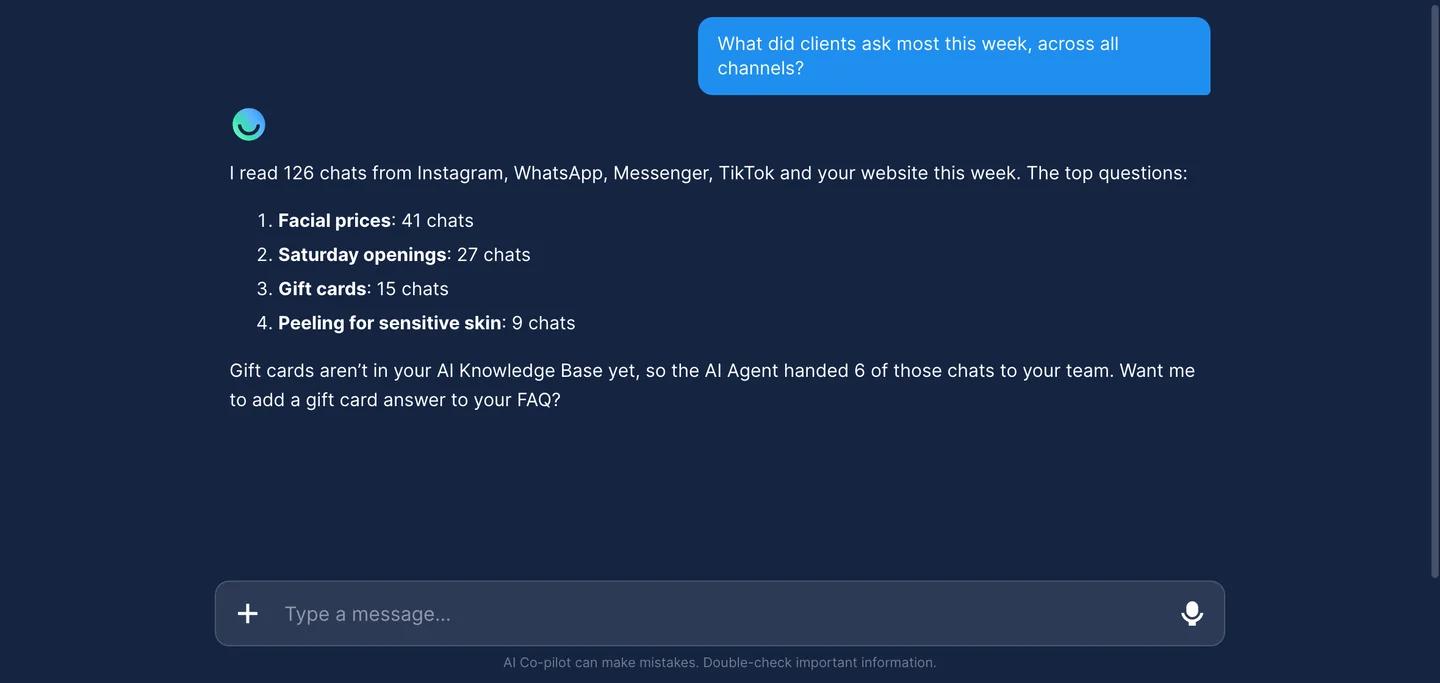
AI Co-pilot can do most of these steps for you: ask it in plain words to add an FAQ answer, turn the AI Agent on for a channel or add a handoff rule. Only connecting a channel needs you to finish the login yourself.
See also: Chatbot best practices: 8 rules for your AI agent
Summary
- Chatfuel fits when your customers write in WhatsApp, Instagram, Messenger, TikTok or website chat, and you want an AI Agent live the same day with your team behind it.
- Intercom Fin fits SaaS and online products that support customers in chat and email.
- LivePerson, Jio Haptik and Yellow.ai fit large brands with contact centers and many channels, on custom contracts.
- Amazon Lex and Google CX Agent Studio fit developer teams on AWS or Google Cloud, especially for voice.
- Oracle Digital Assistant and IBM watsonx Orchestrate fit enterprises already on Oracle or IBM that need agents across departments.
FAQs
What is the best conversational AI platform for small businesses?
For most small businesses, the best choice is a ready-to-use platform that connects to the apps customers already use. Chatfuel's AI Agent answers on WhatsApp, Instagram, Messenger, TikTok and website chat from $20 a month, with unlimited teammates and no developers needed. Developer frameworks like Amazon Lex or Google CX Agent Studio make sense only if you have an engineering team.
What's the difference between a chatbot and conversational AI?
A classic chatbot follows a script: buttons, keywords and fixed answers. Conversational AI understands free-form messages, answers from your business information and keeps the context of the conversation. Many tools now combine the two. For more, see Chatbot vs Conversational AI: Key Differences.
Is there a free conversational AI platform?
Some have free plans with limits: Yellow.ai includes one AI agent and 500 chat sessions a month, and cloud providers give trial credits (Google gives new users $600 or $1,000 on Conversational Agents, AWS up to $200). Chatfuel has no free plan, but every plan starts with a 7-day free trial with $15 in credits.
How much does a conversational AI platform cost?
It depends on the pricing model. Chatfuel costs $20 a month with $20 in credits. Intercom charges $0.99 per Fin outcome plus seats from $29. Cloud frameworks charge per use: $0.00075 per text request on Amazon Lex or $0.50 per session on Google CX Agent Studio. Enterprise platforms such as LivePerson and Jio Haptik quote on request.
Can conversational AI hand a chat to a human?
Yes, and it should for refunds, complaints and sensitive questions. In Chatfuel, you set this up in Switch to human agents: describe when a chat goes to a person, what the AI Agent tells the customer and which teammate gets it. The teammate sees the whole conversation in Chats.
