 Chatfuel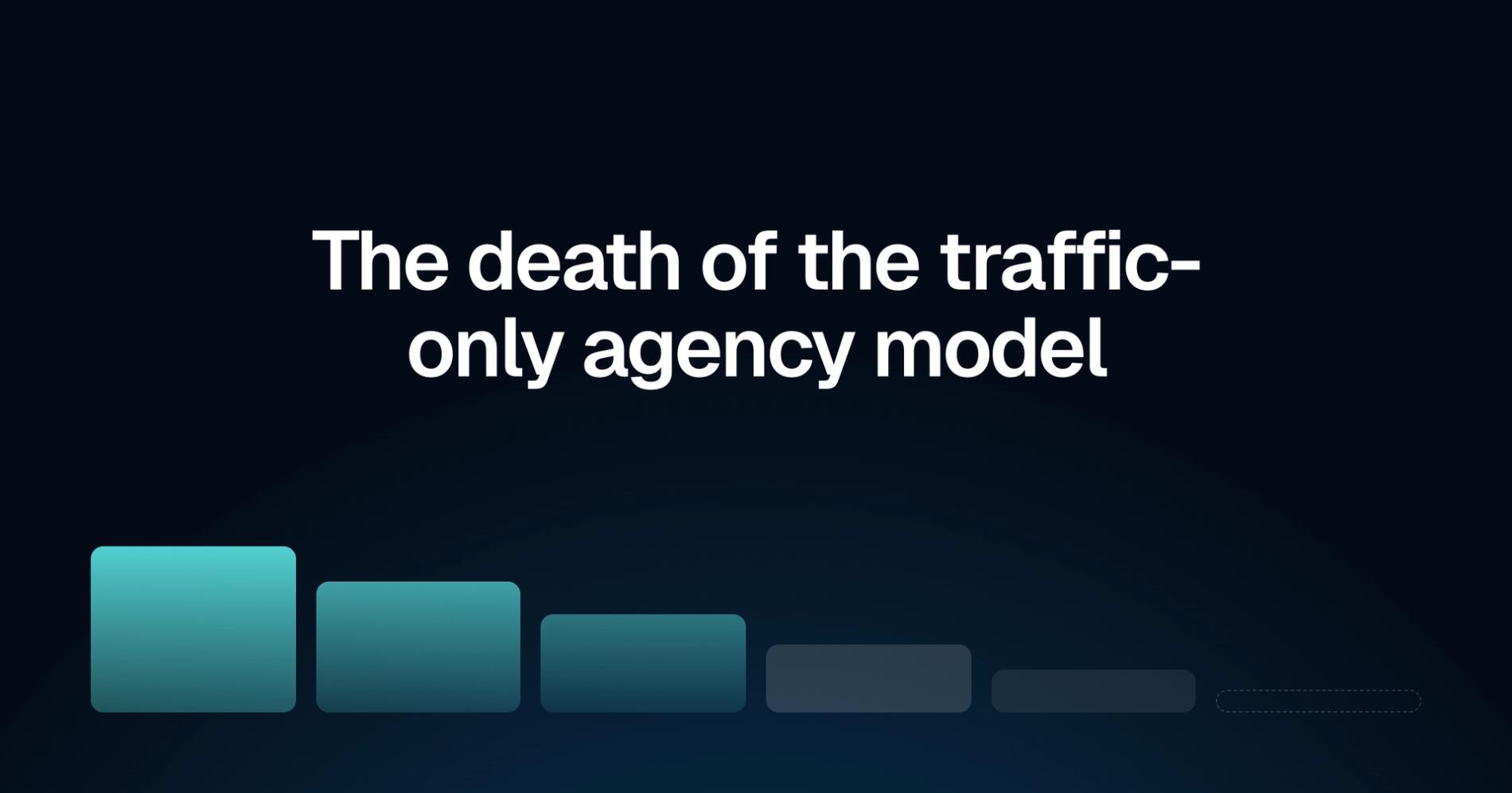
The Death of the Traffic-Only Agency Model
Agencies that sell traffic without owning conversions are becoming obsolete — and the numbers in 2026 make that impossible to ignore.
The traditional agency playbook is straightforward: run ads, drive clicks, deliver leads, send an invoice. But that model has a structural flaw. Standard lead forms create friction at the exact moment a prospect is most engaged, and slow follow-up compounds the damage. Research consistently shows that response times beyond five minutes drop conversion rates dramatically — yet most CRM-only workflows take hours, sometimes days, to action a new inquiry.
Lead leakage is the hidden tax on every traditional funnel. A prospect fills out a form, lands in a CRM queue, and waits. By the time a sales rep follows up, the intent has cooled or a competitor has already started a conversation. Agencies rarely measure this loss directly, which is precisely why clients keep questioning CPL without understanding why pipeline revenue stays flat.
The shift that is redefining agency value is moving from lead generation to lead qualification — and increasingly, to full conversion ownership. Rather than handing off a spreadsheet of contacts, forward-thinking agencies are now delivering sales-ready conversations. WhatsApp lead generation sits at the center of this shift, replacing static forms with real-time, two-way dialogue that qualifies intent instantly.
This is the foundation of the Conversion-as-a-Service model — a structure that lets agencies charge premium retainers tied to revenue outcomes rather than media spend percentages. Understanding why WhatsApp's API makes that model scalable starts with examining the channel's unique ROI advantages.
Why WhatsApp API is the Highest-ROI Channel for Agencies
WhatsApp API is rapidly becoming the single highest-return channel available to any whatsapp marketing agency looking to move beyond traffic metrics and own the full conversion journey.
The core reason comes down to psychology. When a lead clicks an ad and lands on a traditional page, they enter a passive experience — they read, they consider, and most leave without acting. When that same click opens a WhatsApp conversation, something fundamentally different happens. The channel signals immediacy and intimacy, the same environment where people talk to friends and family. That psychological context accelerates purchase intent in a way that static pages simply cannot replicate.
Click-to-WhatsApp (CTWA) ads take direct advantage of this effect. Rather than routing traffic to a landing page that demands a form submission, CTWA ads drop the prospect into a live conversation within seconds. The friction that kills conversion rates — loading delays, form fields, skepticism about data collection — is eliminated almost entirely. In practice, this single structural change tends to lower Customer Acquisition Cost (CAC) meaningfully, because fewer leads drop off between the initial click and the first real exchange.
One practical challenge agencies navigate is the WhatsApp Business API 24-hour messaging window, which closes re-engagement after a day of inactivity. Skilled agencies solve this by triggering immediate automated responses the moment a lead initiates contact, locking in the conversation before intent cools. The result is an open, engaging conversation thread. One client, for example, captured 70% more lead contact data after making this structural shift from passive forms to active WhatsApp conversations.
That data advantage is what makes the infrastructure question so important — and it is exactly what the next section addresses.
Building a Scalable WhatsApp Sales Infrastructure
Agencies that attempt to scale WhatsApp lead generation using the standard Business App quickly hit a ceiling — the API is not optional; it is the foundation everything else runs on.
The WhatsApp Business API removes the hard limits that stall growth: multiple agent access, programmatic messaging, and the webhook connections that make true whatsapp automation possible. Without it, you cannot trigger messages from a CRM event, route conversations by intent, or run concurrent campaigns across dozens of clients. The API is the infrastructure layer; everything built on top depends on its stability.
CRM integration is where most agency builds either succeed or collapse into data silos. Modern API-connected platforms support 136 or more native integrations, meaning contact records, conversation history, and deal stages move automatically between WhatsApp and the tools your clients already use — whether that is a sales CRM, a helpdesk, or an e-commerce platform. A properly connected lead-to-revenue system eliminates the manual handoffs that typically cause leads to go cold between capture and follow-up.
Pre-built funnel templates accelerate deployment significantly. Rather than building qualification flows from scratch for every client, agencies can deploy proven conversation sequences — welcome messages, discovery questions, objection handlers — and adapt them to a vertical in hours, not weeks. The diagram below illustrates a typical infrastructure stack: API connection at the base, CRM sync in the middle layer, and automated funnel templates sitting above that, feeding qualified contacts upward into a reporting dashboard.
Automated ROI reporting closes the loop that most agencies have historically left open. By tagging each lead at the point of WhatsApp entry and tracking that contact through the CRM to a closed deal, you can produce a direct attribution report — this conversation became this sale, worth this dollar amount. That closes the "prove it" gap with clients and, as the next section explores, creates the data foundation needed to productize qualification as a recurring monthly service.
Productizing AI Lead Qualification for Recurring Revenue
AI lead qualification has fundamentally changed what agencies can sell — transforming a one-time campaign deliverable into a monthly retainer service that generates compounding value for clients.
The shift from manual to automated. Most agencies still rely on human agents to field the first wave of inbound WhatsApp messages — an approach that does not scale and bleeds margin fast. The more sustainable model is deploying AI agents that handle initial discovery automatically: asking qualifying questions, capturing budget ranges, confirming timelines, and scoring intent — all without a human in the loop. In practice, this means a prospect who clicks through from a click to whatsapp ads campaign receives an immediate, structured conversation that gathers the data a sales team actually needs.
Packaging this as a retainer. The productization logic is straightforward. Rather than billing for setup alone, agencies charge a recurring monthly fee to maintain, optimize, and report on the AI qualification layer. Clients pay for consistent lead quality, not just lead volume. This reframing resonates strongly with performance-minded buyers because it ties agency revenue directly to pipeline outcomes. AI-driven automation can scale revenue in ways that manual processes simply cannot match at equivalent cost.
Routing and follow-up as the revenue multiplier. High-intent signals — multiple questions asked, a budget confirmed, a timeline stated — should trigger an immediate handoff to a live sales rep via CRM notification or direct message alert. And for leads that go quiet, automated follow-up sequences close what is often called the "Follow-Up Gap": the window between ad click and conversion where most paid media budgets quietly leak. Agencies that automate the handoff from ad click to conversation tend to report meaningfully shorter sales cycles for their clients. This infrastructure sets the stage for understanding how the ads themselves — particularly Click-to-WhatsApp campaigns — need to be structured to feed the qualification engine effectively.
Optimizing Click-to-WhatsApp Ads for High-Intent Leads
The gap between a clicked ad and a closed deal is where most agencies lose revenue — and click-to-WhatsApp ads, built around a strong whatsapp sales infrastructure, close that gap faster than any other format.
Ad Spend → CPL → Conversations → Qualified Leads → Revenue is the new agency roadmap, and every step in that chain depends on what happens in the first seconds after a prospect taps your client's ad. A poorly designed click-to-WhatsApp (CTWA) ad creates confusion; a well-designed one creates momentum.
Ad creative alignment is the foundation. The ad copy and creative should explicitly signal that tapping the button opens a conversation — not a landing page, not a form. Phrases like "Chat with us now" or "Get your quote via WhatsApp" set the right expectation and pre-qualify intent before the conversation even starts. Prospects who click knowing they are entering a chat are meaningfully more engaged than those who stumble in.
Automated triggers are what turn that intent into a structured interaction. The moment a prospect taps through, an automated welcome sequence should fire — greeting them by name when possible, referencing the specific ad or offer they responded to, and presenting a short qualifying question. Waiting even a few minutes can cause drop-off; automation eliminates that delay entirely and ensures every lead receives a consistent first response.
Lead segmentation begins with how a prospect responds to that opening message. Someone who answers a budget question immediately signals higher purchase intent than someone who asks a generic inquiry. Tagging leads based on their initial interaction allows your client's CRM to route them into the appropriate remarketing sequence — whether that is a nurture flow, a direct sales follow-up, or a re-engagement campaign days later.
Conversational capacity is the final variable agencies often overlook. Scaling ad spend without matching automation depth creates a backlog that erodes the speed advantage WhatsApp provides. The right balance is not hiring more agents — it is building qualification flows deep enough that human involvement is reserved for genuinely sales-ready conversations. That balance is exactly what determines whether a WhatsApp program scales profitably, which is the bottom line worth examining next.
The Bottom Line: Scaling Your Agency with WhatsApp
WhatsApp is the bridge between traffic and revenue — and agencies that deploy it as a structured service, not a one-off tactic, are the ones building sustainable, scalable businesses.
The opportunity is straightforward: clients already spend heavily on driving traffic, but conversion remains the weakest link in most funnels. Positioning yourself around that gap, with WhatsApp Business API for agencies as the operational backbone, gives you a service layer that clients can see, measure, and justify renewing every month.
Automation is what separates a productized service from a time sink. Without it, every new client means more headcount, more manual follow-up, and thinner margins. With it, your team manages the strategy while the system handles the repetitive qualification, nurturing, and routing work at scale. As Chatfuel puts it, the goal is the system that proves which lead became a sale — and automation is what makes that proof reproducible across every account you manage.
CRM integration is the retention mechanism most agencies overlook. Clients stay when they can see a direct line between your service and their revenue. Integrated reporting closes that loop, transforming monthly conversations from "what did we do?" to "here is what we drove."
The fastest path to margin is starting with pre-built templates and proven flows rather than building from scratch. Here is what that foundation looks like in practice:
WhatsApp as a revenue layer: Agencies that position WhatsApp as the conversion bridge between paid traffic and closed deals create a service clients understand and will pay a premium to retain.
Automation enables scale: Pre-built AI qualification flows let your agency add clients without adding proportional headcount, protecting your margins as volume grows.
CRM-linked ROI reporting drives retention: When clients can trace every closed deal back to your system, churn drops and contract renewals become predictable.
Templates reduce setup friction: Starting with proven conversation templates minimizes time-to-launch, maximizes early results, and demonstrates competence from day one.
The model works. But knowing the components is different from having a repeatable system for deploying them. The next step is translating this framework into an implementation plan your agency can execute immediately.
Implementing Your WhatsApp Revenue Engine
The agencies that win with WhatsApp do not experiment indefinitely — they follow a disciplined four-step path from audit to automated revenue.
The starting point is always the funnel audit. Before adding any new tool or tactic, map where leads are currently dropping off across your clients' conversion paths. A common pattern is that the biggest leakage points sit between ad click and first response — the window where a prospect's intent is highest and a slow reply costs the sale. Identifying those gaps gives you a clear, evidence-based case for change that clients immediately understand.
Platform selection is the next critical decision. Look for a solution that combines zero-setup AI — meaning pre-built conversation logic that activates without months of custom development — with deep CRM integration so every WhatsApp interaction is logged, scored, and routed automatically. WhatsApp marketing software built for agencies typically bundles these capabilities together, making it far easier to deploy across multiple client accounts without rebuilding infrastructure each time.
The pilot campaign is where the model earns its credibility. Launch a single click-to-WhatsApp campaign for one client, set clear conversion benchmarks, and let the data speak. Demonstrating a measurable lift in qualified leads within the first 30 to 60 days creates the internal momentum needed to expand the engagement.
From there, the transition to a System for Automated Leads (SAL) becomes a natural conversation. The SAL model repositions your agency from a campaign executor to a revenue infrastructure partner — one that delivers predictable, recurring lead flow rather than one-off results. That shift in positioning is what drives higher retainers, longer contracts, and the kind of scalable growth that defines a true Conversion-as-a-Service business.